


Introduction
Amid the rise in global popularity and circulation of K-pop, Western media often stigmatizes K-pop as a mere reproduction of Western pop culture. K-pop dance, however, stems from Korea's institutionalized elite arts middle and high school curriculum and is even extended to an official major in Korean universities. K-pop dance mediates artistry and industry, pedagogy and commercialism, and Korean heritage and Western culture, as shown by K-pop idol G-Dragon's (called "the King of K-pop") studying traditional theatre at arts middle and high schools. Drawing from autoethnographic fieldwork and on content analysis of G-Dragon's DRAMA (2025) music video choreography, I argue that K-pop dance stems from Korea's long legacy of syncretic and prodigy performing arts education.
I first review the status of Korea's arts middle and high schools as well as the emergence of idol academies. Then I provide a performance review of a traditional performing arts concert I attended in Seoul in 2025. Performed by students of the National Middle and High School of Traditional Korean Arts, where G-Dragon graduated from, the concert exhibited an enchanting tapestry of modern K-pop and tradition. Lastly, I offer a close reading of G-Dragon's DRAMA music video choreography that seamlessly integrates Western and Korean performing arts.
Korea's Arts Middle and High Schools
Traditionally, dance education in Korea has centered on three fields: modern dance, ballet, and Korean dance. Here, Korean dance integrates traditional court, folk, and contemporary dances. Accordingly, arts middle and high schools have developed their curriculum to prepare students for top university entrance examinations as dance majors. Seoul Arts High School and Sunhwa Arts High School in Seoul are elite institutions that provide pre-professional training in these three major fields and have produced world-renowned artists. Yewon School and Sunhwa Arts Middle School serve as the primary feeder schools for the aforementioned high schools, respectively.
I started my traditional Korean dance training at the Little Angels Children's Folk Ballet of Korea. Founded in 1962 and modeled after the Vienna Boys' Choir, the company is a youth troupe consisting of girls between nine and fifteen years old. Serving as a cultural ambassador, the company has performed in over sixty countries, presenting Korean traditional dance and music to audiences worldwide in celebration of the resilience and heritage of postwar Korea, particularly during the 1970s and '80s. When I performed with the company, it was almost as prestigious as today's top K-pop agencies. Talented and conventionally pretty young girls joined the company. Indeed, many of my classmates later became renowned actors and broadcast announcers.
Attending Sunhwa Middle and High Schools as a dance major was common for many Little Angels alumnae, a path I also chose. As a ballet major at Sunhwa, I was privileged to perform as a junior company member with Universal Ballet, a leading company in Korea, in various roles from The Nutcracker to Don Quixote. Sunhwa's "stewardess style" uniform featured a tailored blazer, skirt, and scarf-like necktie, and it was frequently cited in the 1990s and 2000s in magazines and popular culture as an example of sophisticated, prestigious school attire. The Sunhwa uniform was as recognizable as that of the Hanlim Arts School, a leading arts high school specializing in K-pop. When I was in middle school, idols like H.O.T. and S.E.S. had just debuted, quickly rising to fame, and street casting was in vogue. After finishing dance classes, I would continue to wear my ballet tights, keep my hair up in a dance bun, throw my school uniform on, and go hang out in Myeongdong with my friends, eating popular Korean street foods and desserts like tteokbokki (spicy rice cakes) and bingsu (shaved ice), and then come home with four or five scouting cards from agencies.
Funnily enough, my friends and I treated those casting offers as nothing special. Back then, entertainers were often dismissed by the derogatory label ddanddara (entertainer, 딴따라), reflecting a strong social tendency to look down on those working in the commercial performing arts industry. Internalizing the prejudice even at an early age, I was so proud of myself as a ballet major. Elitism was pervasive among teens, so we believed that except for Seoul Arts High School, Sunhwa Arts High School, and the National High School of Traditional Korean Arts, other arts schools were for those who were not interested in academics and just wanted to keep playing around.
The National Middle and High School of Traditional Korean Arts are state-run institutions specializing in Korean performing arts. Students receive systematic training in both theory and practice alongside general academic subjects. The high school offers three majors—Korean Music, Korean Dance, and Korean Music and Theatre—to preserve and transmit Korea's traditional performing arts and cultural heritage. The first two majors emphasize training in various forms of traditional Korean instruments and dance, while the third major centers on comprehensive performing arts education that includes the mastery of traditional performance techniques, such as gugak (traditional Korean music) and pansori (traditional Korean opera), as well as acting, vocalization, speech, singing, stage movement, and musical choreography. Graduates frequently continue their education at the Korea National University of Arts (K-Arts) or join professional ensembles such as the National Gugak Center.
The Rise of Idol Academies
As a graduate of a classical arts school, I have witnessed a gradual subversion in Korea. K-pop, once not even considered a legitimate genre by many, has encroached upon and nearly overtaken classical dance education. Several rising high schools, such as Hanlim Arts School and the School of Performing Arts Seoul (SOPA), are known as "idol academies" due to the large number of students debuting as K-pop idols. Schedule conflicts are common for trainees attending ordinary high schools. According to Hyun Seok Hun, a K-pop pre-trainee teacher, "Trainees practice from after school to 10 p.m. Technically, the schedule ends at 10 p.m., but to prepare for the monthly test, they practice until 2 or 3 a.m., then go to school in the morning, return to the studio at 4 p.m., and repeat the process again." Although K-pop trainees do not always quit school but continue in regular schools, some drop out due to unavoidable absences, take the GED (high school equivalency exam), or transfer to arts high schools such as Hanlim or SOPA.
It was not until the late 2000s that enrollment began to skyrocket at Hanlim and SOPA, despite their relatively marginalized status compared to the classical arts schools mentioned above. Currently, the "idol academies" Hanlim and SOPA are the top two arts high schools for K-pop. Their reputation has been elevated by K-pop idol alumni such as IVE's Jang Wonyoung, EXO's Kai, BTS's JK, Astro's Cha Eun-woo, and LE SSERAFIM's Kim Chaewon, to name a few. The schools focus on practical arts such as practical dance, applied music, acting, film, musical theatre, broadcasting and visual media, and fashion modeling. Practical dance and applied music are popular majors for K-pop idols and idol trainees. Their graduation ceremonies are held privately, as many top idols attend as alumni. SOPA evokes romantic high-school K-drama fantasies among fans, who even purchase its school uniform as fan merchandise.
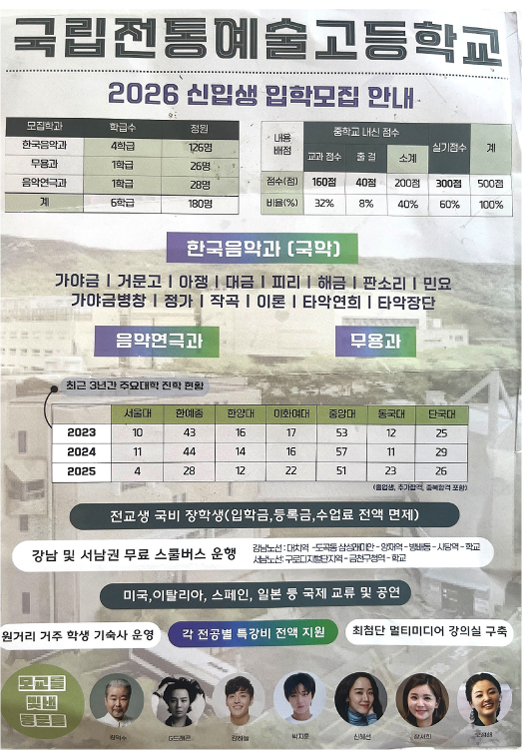
Entrance into these high schools is highly competitive. Private dance academies display posters announcing when their students are accepted. Unlike most Korean high school students who are obsessed with getting into prestigious universities, students at those idol academies are less interested in college admission and often defer or forgo university, since many have already achieved their dreams of becoming top idols.
While notable schools are located in Seoul, regional arts high schools in cities such as Busan, Daegu, and Gwangju offer specialized dance education beyond Seoul. Busan Arts High School is known for BTS's Jimin, who was admitted as the top overall student there, the first ever from the Department of Dance. Although he later transferred and completed his secondary education at Korea Arts High School in Seoul, he later donated 1,200 desks and chairs to replace all the furniture at his alma mater while training as an idol at HYBE. Responding to global demand for K-pop education, the High School of Korean Pop and Performing Arts (known in Korea as "Korea K-pop High School") and Busan International K-pop High School were recently established.
In a country where the university entrance rate for 2025 is 78%, going to college is not uncommon for idols. While many K-pop idols opt for online universities for flexibility, some pursue conventional university paths, majoring in relevant fields such as broadcasting, entertainment, media, and culture and arts business administration. This high enrollment rate reflects not only credentialism in Korean society, suggesting that higher education remains necessary even for entertainers, but also idols' own will to prepare for their careers after retirement, such as teaching at a university. Interestingly, while idols tend to choose majors in theoretical fields such as business, those who were trainees but failed to debut, as well as those who aim to become professional performing artists, choose a major in practical music or practical dance, which includes K-pop.
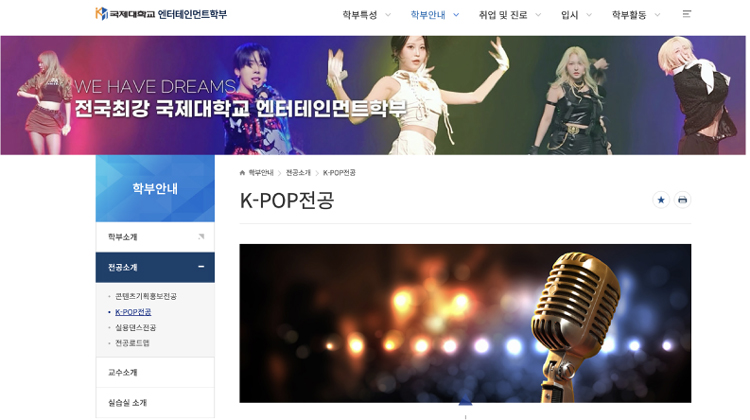
As I demonstrate in my book K-pop Dance: Fandoming Yourself on Social Media (2023), K-pop has been fully institutionalized in Korea as an official music and dance genre. A handful of colleges offer K-pop dance, largely under the name "Practical Dance Major," including Seokyeong University, Korea National Sport University, Seoul Institute of the Arts, and Dong-ah Institute of Media and Arts. Some universities even offer a degree program and major called "K-pop." Kookje University has a K-pop major, along with a Practical Dance Major in the Department of Entertainment. Paekche Institute of the Arts also has a K-pop Department specializing in K-pop vocals, dance, and A&R (artist and repertoire).
K-pop in the Genealogy of Traditional Performing Arts
In summer 2025, I taught a study abroad course, ISS 3300: K-pop Dance & Social Media, at Sungkyunkwan University's International Summer School (SKKU ISS) in Seoul. During the weekly fieldwork, I brought my students to the National Gugak Center at the Seoul Arts Center to attend a traditional performing arts concert by the National Gugak High School. Gugak refers to traditional Korean music and performance.
In the theatre, we waited for the performance to begin while listening to an English introduction. On the screens flanking the stage, titles, synopses, and choreographer information were provided in both Korean and English to help foreign audiences understand the performance. The program proudly listed the number of graduates accepted into prestigious Korean universities who went on to major in dance, music, or acting, along with photos of alumni who became celebrities and K-pop idols. The two categories highlight what is valued in Korean performing arts education and what children are expected to achieve: fame through the K-pop industry or admission to a prestigious university.
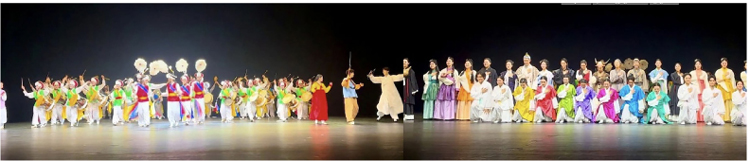
As the show began, dancers entered the stage in sweeping hanboks. The costumes that students had previously seen only in K-dramas or at Gyeongbokgung Palace became real onstage. The dancers' circular arm gestures carved the air with deliberate rhythm, reflecting heung (흥), an affective energy of exuberant joy and excitement that traces back to ancient shamanism. This energy continues to shape both daily rituals, the arts, and performance in Korea. Meanwhile, percussionists repeated shoulder shudders and head shakes while rhythmically stomping their feet until the pace built to a near state of catharsis. The concert carried a striking resonance with K-pop not only in shared choreographic elements but also in foundational educational goals: prodigy training, an emphasis on versatility and synchronous group dancing, all precursors to K-pop dance.
First, like K-pop idols, they have gone through a systematic prodigy education. The curriculum could not be more inclusive. They learn the arts from Korea's intangible heritage, and just as K-pop idols are trained, they also learn English so they can introduce themselves to a global audience. Thanks to government support, tuition is free. This self-sufficient connection between education and the job market resembles the system where K-pop idols grow up admiring and imitating their senior idols at the same agency. Students model themselves after their seniors and often secure jobs at the same companies that tour globally. During the show, they played an introductory video from the school featuring students enrolled there, similar in style to a high school K-drama. Students ended the video by saying, "I want to be the next Korean Wave star!" My students could not believe that the performers were as young as fourteen. Their completely rehearsed movements, charismatic stage presence, and professional facial expressions were nearly as perfect as those of adult professionals.
Second, the syncretic versatility of the students resembles that of K-pop idols. The concert featured a wide range of performances and repertoires, including ritual dances like salpuri (traditional dance), samul nori and pungmul nori (traditional percussion music and dance), and jultagi (traditional tightrope walking), as well as court music and modern dance pieces reinterpreting tradition. The modern works were especially notable: Dancers' feet and arms were rooted in traditional movements, but the music, costumes, and sharp, repetitive upper-body motions were distinctly modern. In a beautiful display, the calm and grounded steps derived from traditional dance training gently permeated their modern, stylistic bodies, creating a sense of heavenly lightness and surreal imagery onstage. Just as the perfect balance between singing and dancing is a defining factor of K-pop technique, most traditional repertoires integrate dance movements with singing and playing musical instruments, and vice versa. Music and dance were so closely integrated that it was often difficult to distinguish whether the performers were majoring in music or dance.
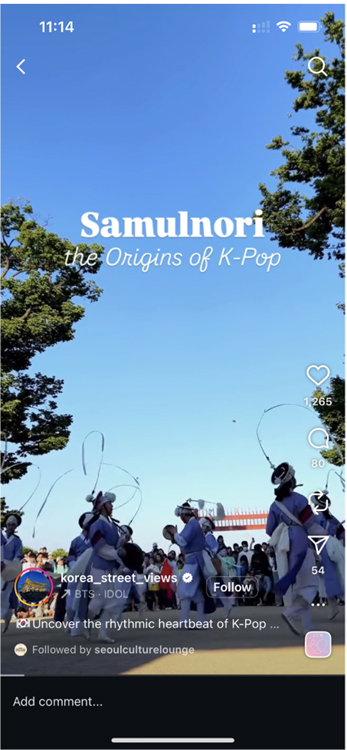
Lastly, the concert was largely composed of a synchronous group dance in a clear floor pattern. Group dances unfolded in precise floor arrangements, bodies swaying in unison, before breaking into solo flourishes. In a performance of sangmochum—a traditional Korean farmers' dance performed with a long-ribboned hat—performers spun their ribboned hats in perfect synchronization, creating widening arcs. The repetitive, fast, sharp headshakes performed in groups with continuously intensifying percussion evoked a sense of ecstasy akin to catharsis. The circular arm gestures, ecstatic drumming, and synchronous formations framed by traditional patterns on the costumes and props were novel yet familiar, largely due to BTS, who once revived many of these styles onstage. The solemn, airy movements of salpuri and the percussive pungmul evoked Jimin's solo performance at the 2019 Melon Music Awards (1theK) and BTS's "IDOL" group performance the previous year at the same venue (BANGTANTV). I later demonstrated in class how the soft circular sweep of salpuri with a white scarf became a sharper, popping-like motion in BTS's stage performance, more legible through the two-dimensional screen and instantly gripping for audiences.
The field trip allowed students to witness the foundations of K-pop dance, which are not simply influenced by or modifications of Western dance, but rather deeply rooted in living Korean heritage and its transmission through passionate young artists. In the lobby after the show, we encountered well-groomed young men wearing light makeup and fashionable clothing, like idols. My students stopped abruptly and looked at me with curious faces, whispering, "Professor, who are they?" I could not answer who the celebrities were, but the students lingered in the lobby for a while, conversing and looking around with visible excitement.
G-Dragon: A Confluence of Modern K-pop and Korean Traditions
As I've explained, although K-pop often appears as a modern, somehow Westernized music performance, it stems from the foundation of Korean performing arts and its education. From the legendary group Seo Taiji and Boys in the 1990s to trot singer and idol Jung Dong-won in the 2020s, K-pop dance and music draw heavily on traditional Korean performing arts. In 2022 in Seoul, I met Lia Kim at the 1MILLION Dance Studio, followed by a meeting with its manager to discuss possible collaborations. During the meeting, I explained that I appreciated Lia Kim's integration of traditional Korean dance. To my surprise, the manager said in Korean, "Only a few experts like you would recognize the influence of Korean dance, though." Kim's graceful, clear lines and poised attitude add a unique Korean aesthetic to her primary training in street dance.
Indeed, when I interviewed Bae Yoon-jung, a prominent K-pop choreographer, she said, "K-pop dance has everything. It is a mix of many things like jjamppong or bibimbap. What is unique is that we make it our own and the adapted version is even better than the original." When drawing multicultural elements to K-pop, artists do not just superficially appropriate them but rather go through decades-long mastery and embodiment of techniques, plus adding uniquely Korean tastes. Bae referred to such syncretic adaptation that exceeds the original as jjamppong (a Chinese-style spicy noodle soup with various mixed ingredients) and bibimbap (a rice dish with assorted ingredients).
G-Dragon is a prime example of integrating Korean tradition and Western culture to K-pop. While many people associate G-Dragon with hip hop, his official artistic training belongs to the lineage of Korean music and dance. He majored in Korean Music and Theatre at the National Middle and High School of Traditional Korean Arts. While many pioneers of K-pop dance were street-born talents, G-Dragon is a trained genius. Although G-Dragon rarely speaks about it, he mentioned this background when he appeared on the variety show Infinite Challenge, recalling that he played the role of Samdori in a traditional outdoor folk theatre performance (Im). Samdori is a stock character typically portrayed as a witty, mischievous young man from a humble background. Serving as comic relief, he often uses playful antics to criticize authority or highlight social tensions.
In a musical performance video known among fans as the one G-Dragon had asked "never to be uploaded," he wears a fake mustache and overalls resembling those worn by members of the working class in the 1970s (@jiyong__like88). Onstage, he jolts lightly, playfully sings, and speaks with humor and satire in front of a group of musical performers. The performers embody rhythm through their curved postures, finger-snapping, and percussive footwork, kicking their legs and stamping their feet in the style of musical-theatre dance. Notably, although he was only around fourteen years old and in middle school, his iconic stage persona—light steps, lean, sharp, and angular body lines, airy, fluid arm gestures, and a fragile but strongly expressive voice—was already foreshadowed and even recognizable as G-Dragon. It is known that he taught himself rap and dance outside the classroom. His years as a trainee at SM Entertainment and later YG Entertainment overlapped with his schooling, creating frequent tensions between academic obligations and artistic practice. Eventually, he transferred to Dongducheon Information Industry High School, which was less academically rigorous, to prepare for his debut.
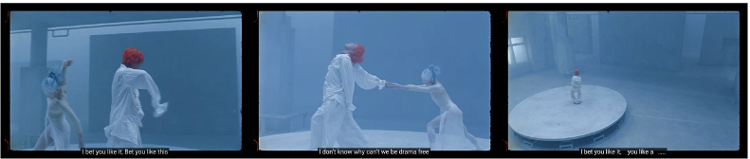
Through his lifetime of learning and stage performance in dance and music across Korean, Western, academic, and industry spheres, G-Dragon has become a genre of his own, transcending the boundaries imposed by educational and societal institutions. His music video DRAMA (2025) embodies him as a genre stemming from his versatile training background. On a stark white, worn-out vintage circular stage surrounded by hazy, mist-infused blue light, G-Dragon appears as a tragic Pierrot, dressed in white theatrical garments trimmed with lace and bearing a large wind-up key affixed to his back. His movements unfold as though drawn by the force of love, yet he simultaneously searches for selfhood, probing and gazing inward, performing fluid, ethereal contemporary dance. At moments, he parodies ballet, stiffly bending his legs into a sideways plié and bringing one arm softly across the front of his torso, reminiscent of an en bas pose. He wields a hand-flourishing gesture common in European theatre, and then moves stiffly, like a rusted robot, referencing a basic breakdance move. His gaze is heavy and mournful, and his face is delicate and youthful, like the Little Prince. His orange-dyed hair and painted freckles, veiled by orange shadow and blush, evoke a surreal, dreamlike figure flushed with fragile love. The music video's theatricality is further enhanced by his duet with a female dancer draped in sheer white fabric adorned with lace and floral decorations.
At times, the female dancer touches his shoulder from behind, then descends to the floor. G-Dragon glances at her hand and quickly turns his head away with an airy motion initiated by a flicking shoulder twist that changes direction, which generates the following fluid move from the elbow to the fingertips. His movement carries his breath with a buoyant rhythm, as if soaring through the air, and strongly resonates with salpuri (traditional Korean dance originating from a spirit-cleansing shamanic ritual), which highlights breath as a core technique creating a natural bodily rhythm through deep inhalations and exhalations. He then gestures as if he were an orchestral performer, followed by footwork reminiscent of a wooden marionette, before turning his feet out into first position and lowering into a plié. This movement, which appears to be an unconscious, improvisatory release of the body, reveals the foundational training vocabulary that has accumulated in him over many years. The choreography, which references Korean and Western dance and theatre, appears improvisational, resembling freestyle contemporary dance, especially in his solo.
G-Dragon's dance, which largely appears choreographed, is dreamlike and delicately surreal. Improvisation is widely used among professional dancers to convey authentic, deep emotion as a form of autobiographical storytelling, moving away from a purely technical display. It is not surprising that the choreography credits are not publicly disclosed. His serene, poetic, and delicate movements are so autonomically embedded in his body—one that has mastered innumerable techniques—that they are almost impossible to imitate. His body is his dance; each gesture resists separation into discrete movements. He has attained a state of mastery where every gesture, however minimal, unfolds as dance. He cannot be confined to any single genre; rather, G-Dragon himself becomes a genre of dance.
Such a unique blend of traditional Korean arts, hip-hop, Western theatre, stage etiquette, and acting would not be possible without several decades of embodying techniques that seamlessly bridge Korean cultural heritage and global popular music and dance. It is his boundary-crossing training that has made him "the King of K-pop." BTS's JK often cites G-Dragon as the role model who inspired him to become a singer. In an earlier music show broadcast, a rookie-era JK gazes at G-Dragon with wistful admiration as G-Dragon gives his first-place acceptance speech, a clip now well known among fans ("Jung Kook Loves G-Dragon"). As a role model, teacher, and inspiration to many, G-Dragon is continuously reborn even after challenges—military service, the disbandment of his group, and scandal—and still he returns iconic and motivated, as if nothing happened. Easy come, easy go. His power lies in decades-long training; nothing is more valuable than not losing his light onstage, given that his entire childhood was spent in a sweaty dance studio dreaming only of dancing and singing onstage. K-pop idols are not "idols" in the Western sense but instead are professional artists who have gone through prodigy education like Olympic athletes. Recognizing their training backgrounds uniquely embodying and rooted in Korean performing arts education should be considered when discussing their performance authenticity.
Works Cited
Bae, Yoon-jung. Interview with the author. 2 June 2023.
"G-DRAGON – DRAMA (Official Video)." YouTube, uploaded by OfficialGDRAGON, 24 Feb. 2025, www.youtube.com/watch?v=I8I51kSq448.
Im, Su-yeon. "'Infinite Challenge': G-Dragon, Plays Samdori in Traditional Korean Performance 'Madam, Madam,' Evoking Laughter." Xports News, 29 Sept. 2012, www.xportsnews.com/article/260422.
@jiyong__like88. "Video Featuring G-Dragon." TikTok, 28 May 2020, www.tiktok.com/@jiyong__like88/video/6832065178629115137.
"Jung Kook Loves G-Dragon." YouTube, uploaded by soackward, 11 Oct. 2014, www.youtube.com/watch?v=9IIZTkvaInM.
Korea Street Views [@korea_street_views]. Instagram, www.instagram.com/korea_street_views.
"K-POP전공." Department of Entertainment, Kookje University, dept.kookje.ac.kr/entertainment/index.php?pCode=kpop.
National Middle School of Traditional Korean Arts. kugak-am.sen.ms.kr.
Oh, Chuyun. K-pop Dance: Fandoming Yourself on Social Media. Routledge, 2023.