


Terike Haapoja is a contemporary Finnish visual artist, whose work I discuss in my recent article, "When the Warmth Leaves, Where Do We Go?: Sharing the Corpse in Thermography's Necropolitical Aesthetics" (Theatre Journal Vol. 78, no. 1). As with Entropy and In and Out of Time, the focus of my article, Haapoja’s other works from the early to mid-2000s intersected technological politics, the metaphysics of presence and absence, and the historical-materiality of the body-in-performance and visual media. In these aesthetics, Haapoja interrogates the potency of heat and the body’s trace by questioning our perceptions of “life” and “death.”
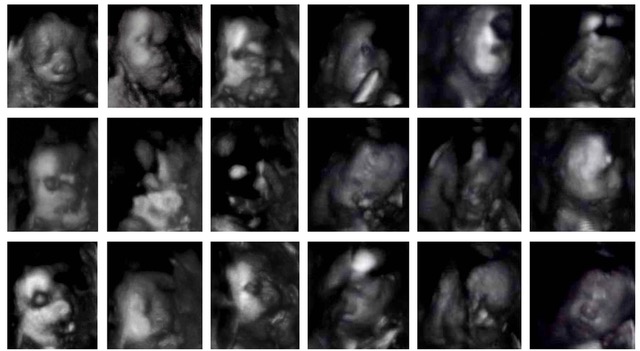
In Mind Over Matter Over Mind (2005), Terike Haapoja uses ultrasound technology to create various video portraits of twenty-week-old human embryos. By shifting the ultrasound apparatus on top of the pregnant belly, the image becomes distorted by the amniotic fluid’s movement and the fetus itself. As such, the video and images produced both reify and blur the recognizable human form. The video portraits for Mind Over Matter Over Mind were hung like paintings in gallery spaces on LCD screens. As Haapoja notes:
As the fetus grows inside the womb, not only does a new form come into being, but a new consciousness also emerges. Matter is transformed into mind; what can be perceived as an object is transformed into a subjectivity with the ability to observe. When we die, this process rewinds, with subjectivity again subsiding and giving way to the object. In most cultures the mind-matter transformation process is the realm of taboo, steeped in ritual and myth.[1]
Like her explorations in Entropy and In and Out of Time, Mind Over Matter Over Mind focuses on the strange, scientific, technological, and mystical rendering of life and death. In effect, Haapoja interrogates technology’s use in helping humans understand biological and deathly phenomena as well as the ways that complete knowledge of such matters continues to remain outside of our purview. A similar work, titled Atlantis (2005), also explores the interfacing of biomedical technology, the body’s materiality, and metaphysical precepts of “life” by pairing rich soundscapes and corporeal gurgles with ultrasound projections of the womb. Haapoja herself puts it best: “The film quality, reminding of old 8mm films, slowly forms images and abstractions, as if one was looking at clouds, or waves in the sea.”[2]
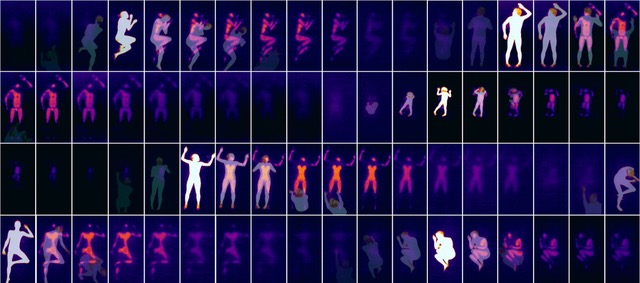
Passings (2005) recognizes the politics and performativity of heat and the body’s trace. To make this piece, Haapoja pointed thermographic cameras at three platforms. A person would rest on these respective platforms for a few moments and then get up. The transfer of heat from their bodies to the surfaces would leave a thermographic trace that lasted for roughly forty minutes. Once one trace was almost gone, another person would lie down to form a fresh imprint. As Haapoja states:
Humans have limited means for perceiving the flow of time. A sense of presence dominates our world: those who have passed away are gone, though we might still feel their presence, like a ghost limb. Other species, however, might experience the world as gradual levels of physical presence. We leave traces of heat or scent and mix in many ways with the surrounding world as we move about. Our presence or absence is never truly absolute – it’s rather just our perceptual limitations that make us think that way.
Infrared camera technology is a key tool in the military, where it is commonly used for finding and targeting the enemy. All technology is built to serve a certain purpose, and so it is necessary that infrared cameras show the target as an anonymous physical process rather than as a living being.[3]
As with Entropy and In and Out of Time, Haapoja wrangles with the metaphysical ideals of “presence” and “absence” in the performative encounter but also ties these thermographic aesthetics to their historical-material role in political violence and war.
[1] Terike Haapoja, “Mind Over Matter Over Mind,” https://www.terikehaapoja.net/mind-over-matter-over-mind/.
[2] Ibid.
[3] Terike Haapoja, Passings, https://www.terikehaapoja.net/passings/.