


In the woods there was magic. Quick, rough magic. And I am no different. I cast many spells. …1
Embraced by twilight hues and a mirage of streetlamps, W Tre (Kyle Beltran) invites audiences into a memory. Anxiously cruising for sex in the park, it was here that the now 40-year-old architect met Free (Nic Ashe), a spirited young songwriter ten years his junior. Although their meeting might strike some as unconventional, the two men are immediately drawn together by a force neither can yet name. In the throes of anonymous passion, Tre and Free find themselves asking the most unlikely of questions: Could this be love?
Tarell Alvin McCraney's 2025 play, We Are Gathered, explores marriage as more than a legal right in the decade following Obergefell v. Hodges, the landmark 2015 Supreme Court decision that legalized gay marriage in the United States.2 Transcending the limits of the "fourth wall," We Are Gathered similarly bequeaths its audiences to renege their personal or political insecurities and, in many ways, to "just commit." In addition to various instances of call-and-response, each performance featured a legally binding wedding between preselected audience members to secure our understanding of both the legal privileges and performative dimensions of marriage.3
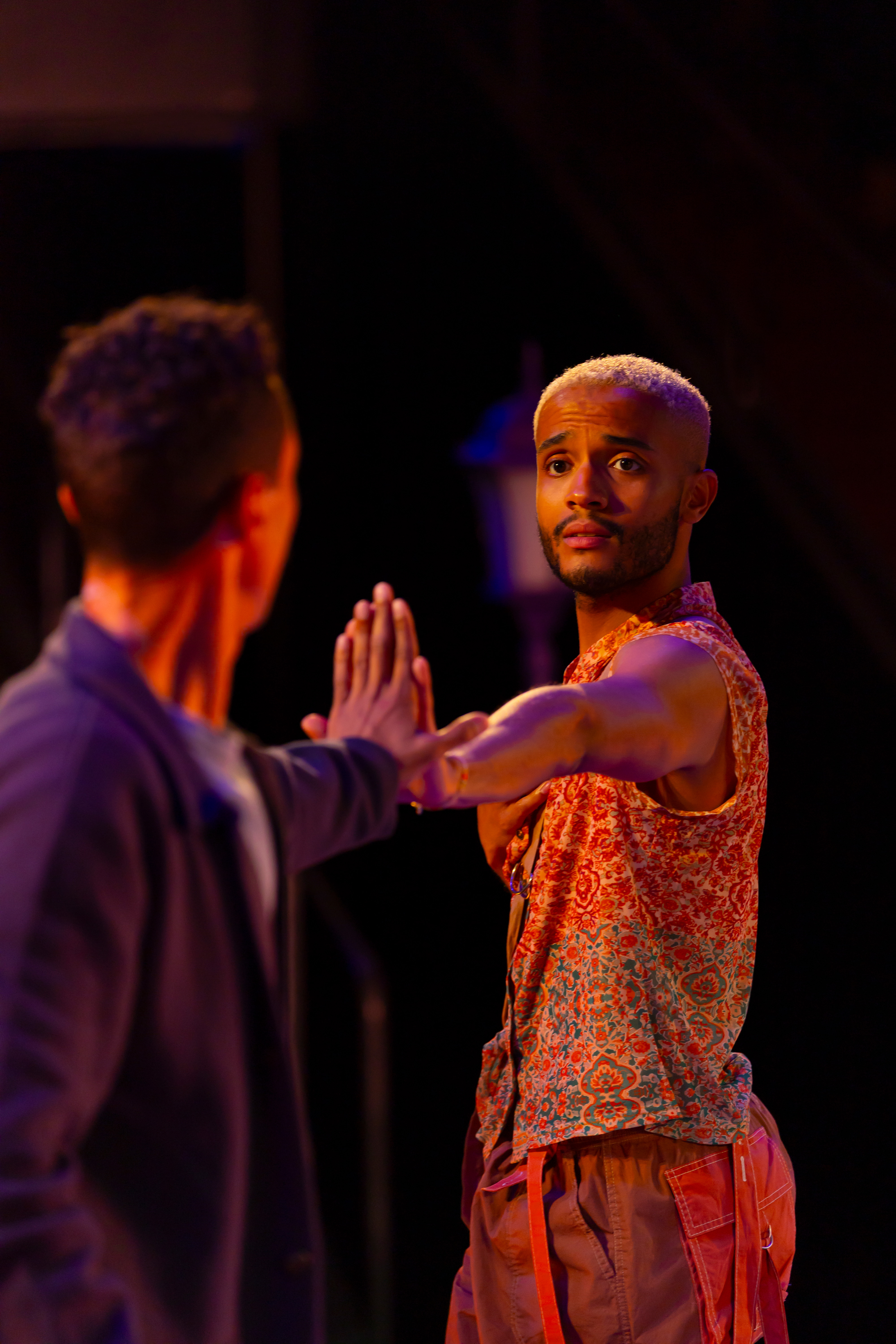
in We Are Gathered at Arena Stage at the Mead Center
for American Theater running May 16–June 15, 2025.
(Photo: T Charles Erickson Photography.)
With LGBTQ+ rights under new scrutiny, the world premiere of McCraney's play at Arena Stage in Washington, DC felt uncharacteristically optimistic, focusing on love as audiences understand it rather than hate as they may have learned it. Tre and Free are two queer Black men who meet in a chance encounter at the park and discover a deep but unexpected spiritual connection. Five years into their relationship, we meet the couple's friends and family: Free's loving grandparents Nana Jae (Jade Jones) and Pop Pop (Craig Wallace); Tre's estranged father, Wallace Tre Sr. (Kevin Mambo); dear friends Chauncey (Mambo) and Xi (Jones); plus, a beacon of the cosmos herself, Tre's highly perceptive astronaut sister, Punkin (Nikkole Salter).
Inspired partly by William Shakespeare's "forest plays," We Are Gathered dares to ask: Without the legal, religious, or gendered conventions that have traditionally shaped marriage as we understand it, where do Black queer men fit within the theatrical expectations of the marriage plot? For every double entendre about forbidden romance or sex in the woods, it's easy to see where plays like A Midsummer Night's Dream or As You Like It venture into queer storytelling. Frequently sidetracked by magic spells and cross-dressing, Shakespeare's endings nonetheless prioritize the privilege of heterosexual marriage. On the other hand, Tre knows he wants marriage—a performative act of devotion that would legally and socially solidify his bond with Free. As Tre considers proposing, he wrestles with a deeper fear that he does not need marriage, a disguised insecurity that he may not deserve marriage.
When it comes to the performativity of marriage, it is tempting to rely on J. L. Austin's definition of speech acts.4 Yet McCraney's play asks audiences—regardless of their academic fluency—to look beyond such vocabulary and embrace those less articulable aspects of human connection. Entangling the transactional nature of legal partnership with the mysteries of human impulse, We Are Gathered confronts the transformative realities of social performance while at the same time highlighting the inexpressible magic that repeatedly brings us home to the theatre.
When I attended an evening performance of We Are Gathered, I was struck by how the intimacy of the performance amplified itself throughout the crowd. Audience members were deeply engaged—sometimes willingly, sometimes hesitantly, but always with some degree of curiosity and compassion for Tre and Free's love story. While the political temperature shifted outside the theatre's walls, the Fichandler Stage became an oasis in the round: a space of togetherness, of humor, and of connection. My conversation with the playwright was equally uplifting. McCraney spoke generously about his inspirations for the play and their impact on his own adult coming-of-age as a queer Black man in the era of Obergefell v. Hodges.
Our phone conversation took place on July 1, 2025, and has been edited for clarity and length.
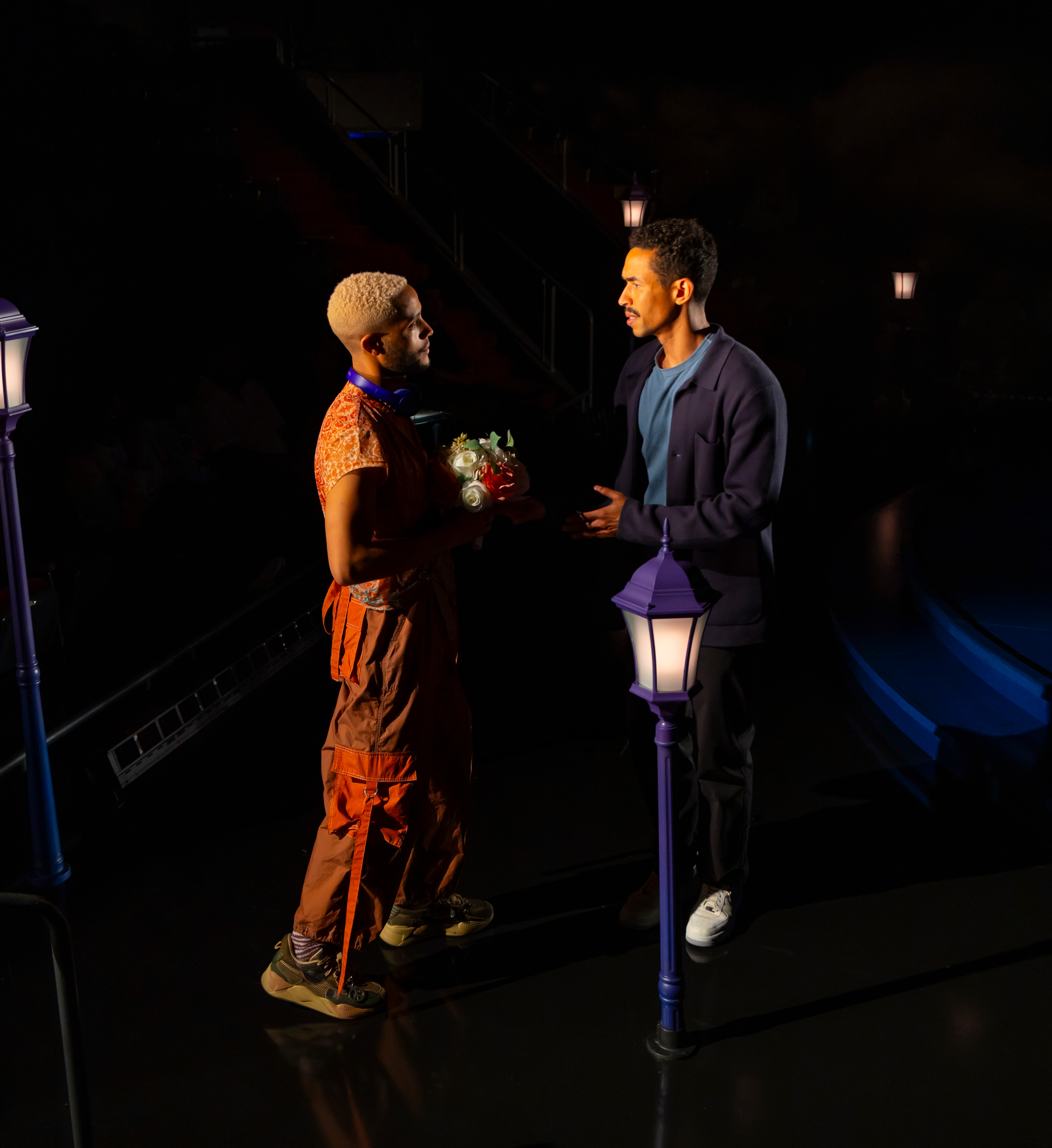
at Arena Stage at the Mead Center for American Theater running
May 16–June 15, 2025. (Photo: T Charles Erickson Photography.)
Melissa Lin Sturges: What inspired you to write a play about gay marriage in 2025?
Tarell Alvin McCraney: I was mostly trying to unpack the ritual of marriage. Why is it so important to us as human beings? Why do all cultures have some demarcation on the union—or the coming together—of two people? There are many different words for it, but almost every known culture anoints, talks about, or marks the occasion of marriage. The argument has traditionally been that marriage is a human right: Two consenting adults should have the ability to marry. The fact that this debate existed was puzzling for me. I never thought of marriage as a need in my life. It wasn't essential to me. My parents weren't married. I didn't grow up knowing many people whose parents were married, or who are still married. So it was interesting for me to explore what the need for marriage actually was.
Marriage between queer people is sort of the newest civil liberty that has been afforded to us. I had fears about that. I thought: If I don't think very well of myself sometimes, how am I supposed to think well of myself partnered with somebody else? How do I wed my own vulnerability to another person? How do I bring my whole self into a partnership if I'm hiding parts of myself? I think that's why people get cold feet. That's why people don't show up to the altars—they say "no" instead of "yes." The thought scared me. I asked: If I'm going into the woods of myself to figure this thing out, will there be any light on the other side? And there was light with We Are Gathered. To celebrate the kind of bravery and commitment to another person that it takes to make a marriage work every night was fortifying to me. I think it was fortifying for many folks. Every night I came out a little stronger in my conviction.
There is a moment where adulthood sort of just "happens." A moment comes when we say, "I am not a child anymore." For couples that are married, or have been married, or who are in the process of getting married, a moment comes when they too mark the occasion of saying "before, I was not married" and "now I am married." They go from being one person to more than one person. That's what theatre is like too—it's a transformation.
MLS: Shakespeare's marriage plots—specifically his "forest plays" like As You Like It or A Midsummer Night's Dream—were a key influence on We Are Gathered. How did these works shape both your inspiration for and the final version of your script? Are there still traces of Shakespeare's influence in the completed play?
TAM: They aren't just traces; Shakespeare is all over We Are Gathered. I'm not hiding that fact in any way, shape, or form. I'm not one to do that. But I'm also not the first playwright to have questions about marriage.
Shakespeare's later plays or his romances like The Winter's Tale always start with the most tragic things. Even knowing that two people are meant for each other, two hours is too long of a time for a play to start with a proposal. A lot of things must happen to get to that moment. But when we get to the proposal in We Are Gathered, we see just how hard it is for those two people [W Tre and Free] to come together, and why Tre was having so much trouble with the idea of marriage. These things can't be perfect, but they are. W Tre's proposal is not perfect, but it is exactly what he needed to do. All of that is certainly stolen from Shakespeare, or borrowed, if you will. But Shakespeare stole all those things from someone else.
MLS: Right, and We Are Gathered celebrates the traditional marriage plot just as much as it questions it.
TAM: Yes, there's a kind of sleight of hand to that. It makes us dig deeper into the relationship up until the point where someone gets down on one knee. We Are Gathered does not subvert our expectations about marriage or theatre in that way. A Winter's Tale doesn't work unless the death of the child and Hermione's banishment are seen as awful because that brings us into the forest—and there's dancing, and there's games, there's cross-dressing, and clowns—and we start to long for the proposal. We need it because, at that point, we've watched a tyrant do terrible things and that cannot be the way the world works. Unfortunately, that's been the experience for so many queer relationships. Everyone says they love weddings, but they'll really love one if they start at a funeral. Shakespeare's marriage plays all start with something terrible. And if that's not an allegory for being queer and in love up until about ten years ago, I don't know what is.
MLS: The proposal scene is my favorite part of the play. I'm curious if you have a favorite moment in W Tre and Free's love story either from the script or during the rehearsal process?
TAM: My favorite moment is when Free bites his mouth too hard.5 He's grinding his teeth at night, and he cuts the inside of his mouth. Tre says, "let me see." And Free asks, "You want to see in my mouth?" And Tre replies, "Yeah, I want to see where you hurt." Tre wipes Free's mouth and kisses him and wipes the blood away. It's so rare to see a moment that intimate and that sweet, let alone a moment between two Black men.
MLS: In We Are Gathered, W Tre speaks of the park as a place where "spells are cast." How do these elements of magic, mythology, and alchemy influence We Are Gathered? Do you find them present in your work as a whole?
TAM: In every transformation, in every ritual, we start somewhere different from where we end. The words in the script are just spells, right? There is an act of active witnessing that must happen in the theatre. The audience sits around the stage, and they watch each other imagine something together. At the start of We Are Gathered, W Tre comes onstage and says to the audience, "You're here. Thank you." Already, there is an offering of gratitude. Then he says, "I should probably say why I'm here, right?" Most times, people say, "Yes" or "Sure." He says, "Okay, great. Thank you. I need that." And then there is a call-and-response. Audiences try to keep a sense of cognitive dissonance going, but cognitive dissonance won't work for this play. There must be active witnessing. "I'm going to tell you where we are," W Tre says, "we're in the park. Have you been?" The audience then begins to recollect what they remember of a park. That's a binding spell, right? That's magic in that sense. The audience is implicated by the spells that are being cast.
MLS: The live weddings at the end of each performance also invoke this degree of active (or performative) witnessing. What was their purpose, and did including them change how you imagined the final moments of the play?
TAM: The weddings were always written into the play. The piece was always written as an invitation for real-life weddings to happen. So I don't know if it changed the ending in any way. What was different about witnessing these weddings from just watching the play is that when audience members witness two people coming together in marriage, they agree to be a part of that marriage for the rest of their lives.
Do you remember the first wedding you ever attended? I do. I was a child in a suit and tie who didn't want to be there, but now I'm forever a part of that couple's story. When you witness a wedding, you become a part of that day for the rest of your life. We often talk about how divided we are, but for this one night, audiences get to be intentional about coming together. Something happens onstage that connects us to one another in our minds and indelibly in our hearts.
MLS: Where do you find the most "magic" in everyday life? Where do you find the most magic in the theatre?
TAM: Children have the most magic. They come into this world full of magic, and if we're smart, we watch them to duplicate that magic. So much of what I do in the theatre is to remember what childlike wonder felt like. We spend a lot of time trying to get back to that sense of wonder or surprise. But we really need to remind ourselves that our 7-year-old selves still live inside us—probably terrified, probably hungry, and probably equally as curious as they were at 7. How do we wake that 7-year-old up? I love the fact that I have so many nieces and nephews and godchildren. The way in which they are curious about life is intoxicating. I need a little bit of that back in my life.
Footnotes
1. We Are Gathered, by Tarell Alvin McCraney, directed by Kent Gash, Fichandler Stage at Arena Stage, Washington, DC, May 17, 2025.
2. Casey Parks, "Gay Marriages Have Doubled in 10 Years Since Supreme Court Ruling," Washington Post, June 26, 2025, https://www.washingtonpost.com/nation/2025/06/26/gay-marriage-overgfellsupreme-court-legalized.
3. Jared Strange, "A Marriage of True Minds in We Are Gathered," American Theatre, May 21, 2025, https://www.americantheatre.org/2025/05/21/a-marriage-of-true-minds-in-we-are-gathered.
4. See J. L. Austin, How to Do Things with Words (Harvard University Press, 1962).
5. McCraney refers to a moment approximately halfway into the play in which W Tre reveals both his desire to and hesitations about proposing to Free, which incite an argument for the couple. The late-night argument dissolves into tenderness but nevertheless points to Tre's inner conflict about marriage.