


Magician and culture worker Benjamin “Black Herman” Rucker promised his audiences in the 1920s and 30s that he would return every seven years—a promise that served both as effective tag line and a potential prophecy. His name has continued to circulate through the post-humous printing of his dream books, oral histories of witnesses to his legacies, and the legacy of his name in figures such as Sun Ra, named Herman “Sonny” Blount. There is something particularly resonant about Black Herman today for artists and stage magicians—perhaps something akin to what Ishmael Reed and Aishah Rahman experienced when they included his expressive persona in their works in 1972 and 1986. The potential force of Black Herman is heard in LaTasha Nevada Diggs poem, black herman’s last asrah levitation at magic city, Atlanta 2010, a sonorous tribute to Black music in/as magic.1 And for contemporary artists Derek Fordjour (b. 1974) and Cameron Granger (b. 1993), Black Herman has provided inspiration for their creative practice. Black Herman thus seems to appear as guaranteed, resurfacing as a character, icon, and threshold through which magic, as performance, art, and possibly more can be seen.
While my essay in Theatre Journal's September 2025 special issue on “Magic” engages with Black Herman’s 1920s illusions, I embrace here a more speculative query, one about what engaging Black Herman—as historical figure, persona, or conjure-man— generates. Our return to Black Herman is, in many respects, unsurprising given both the limit of the archive and the limit of the magician’s own reveal. Black Herman’s legacy is sensational and complex: his own self-creation embraced both flamboyant power and a community presence. The archive reveals the paradox of an imperfect and enticing performer. Black Herman’s multiple sides (stage magician, conjure-man, business-owner, con-artist) brings us back to him repeatedly as we question his tricks (how were they done?), his business (who did he support in 1920s Harlem?), and his hustle (what is at the core?).
Throughout my work, I examine the politics of magic as a signal of belief, a set of performance techniques, and a container for the unspoken material of survival. I work to dismantle the color-coded fusion of “black magic” to mean the dangerous, unsavory, “bad” magic. I have been sitting with these questions for a long time, as I examined a history of technology that both embraced, and rejected, the illusory traditions. And yet, they always came back into focus. Derek Fordjour and Cameron Granger disrupt these old associations, crafting multi-sensory theatrical engagements that, like Black Herman, can remake our view. Black performance magic, in their work, emerges as the site of paradox that can hold the sorrow and joy of Black life.2
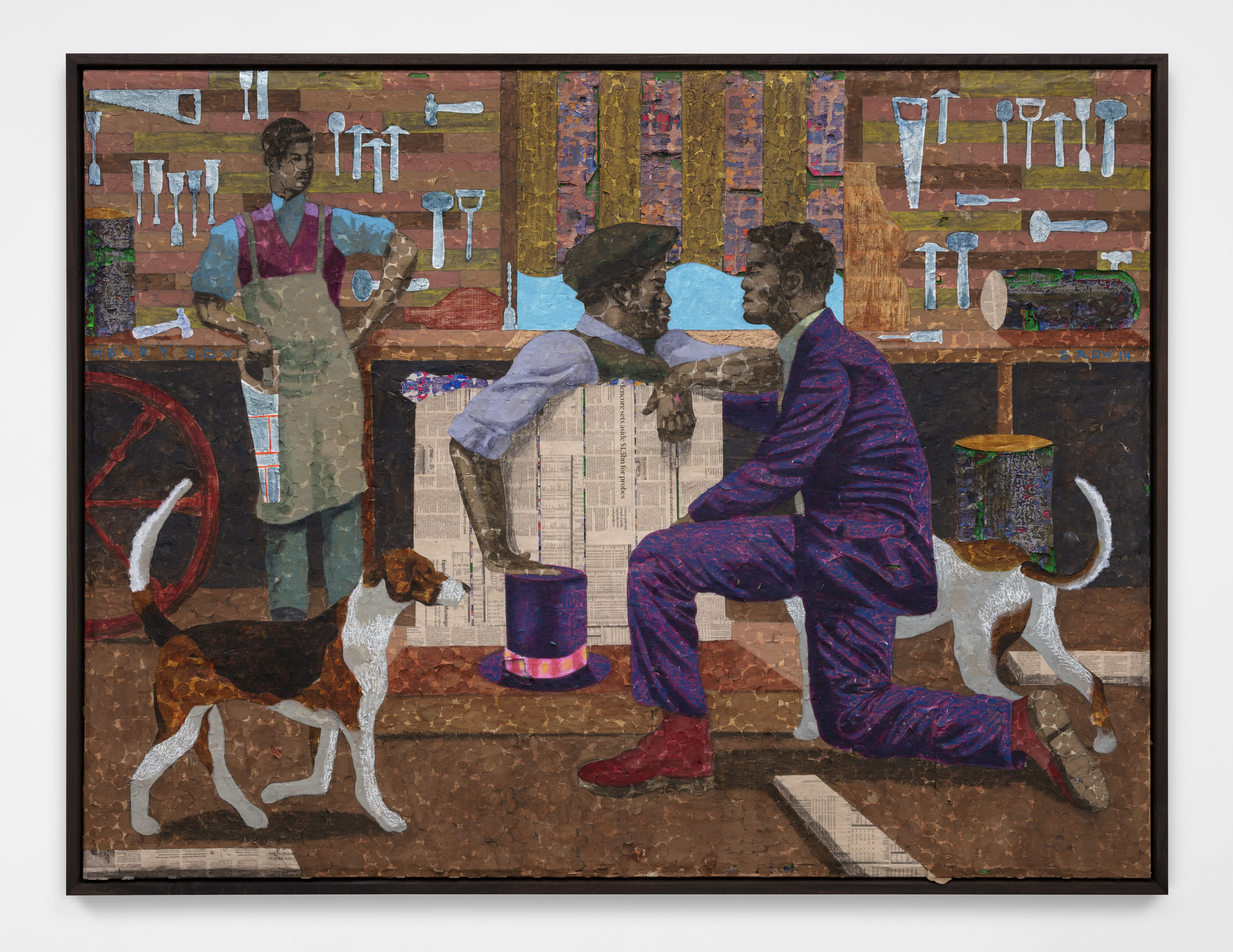
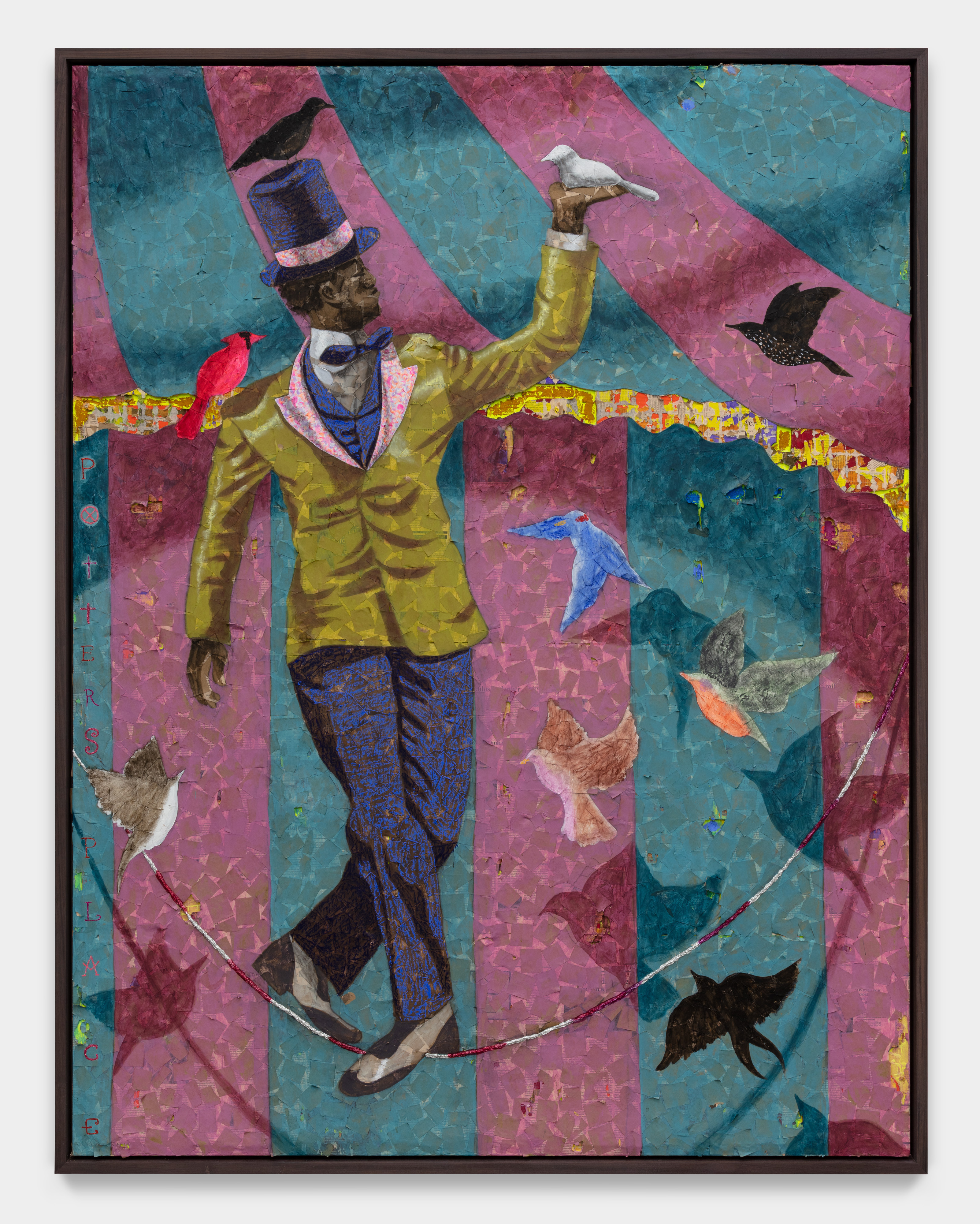
Derek Fordjour is a Ghanian-American multi-media artist who delves into texture, color, scale, and embodiment in his paintings and sculptures. Involved in numerous solo and group shows since 2014, Fordjour has crafted a large corpus of brightly-hued paintings that depict a dynamism of Black life which is reflected in his sculpture and installation work. Fordjour layers various papers, including newsprint, on top of a canvas base, then cuts away into the layers while adding acrylic, oil pastel, charcoal, cardboard, and foil strips to render his figures. Prior to Magic, he created SHELTER, at the Contemporary Art Museum in St. Louis, and SELF MUST DIE, an installation in 2020 at the Petzel Gallery in New York. This latter installation extended “vigilant attendance,” in Christina Sharpe’s words, to the living and the dying amid continual racial violence and a global pandemic.3 Fordjour and a large creative team installed an animated theatrical show that conjured scenes from tent revivals in Tennessee, to the history of the Black jockey, to Black funerary traditions. The show includes Fly Away, co-created with theatre maker and puppeteer Nick Lehane, a puppet show that centers an articulated Black puppet manipulated by four white puppeteers, revealing the often obscured way white supremacy operates in Black life.

Los Angeles, CA, March 26 – May 7, 2022, installation view. Photo: Elon
Schoenholz, courtesy the artist and David Kordansky Gallery
There is a magic in Derek Fordjour’s layering of material, color, and history that holds both clear technique and uncommon revelation. In Fordjour’s solo show Magic, Mystery, & Legerdemain (March 2022), in collaboration with artist/director Numa Perrier, magic becomes the subject refracted through the revivification of Black Herman. Black Herman’s mythos serves as an index for magic: a “living metaphor in which the willful suspension of disbelief is alternately seen as a privilege afforded to some, a luxury unavailable to others, or a necessary mode of survival.”4 The title of the show was inspired by Herman’s published volume of the same name. The exhibition, which started with a procession through a velvet curtain and arched circular walkway, included paintings of Black magicians and their stage acts juxtaposed with backstage scenes, musical vistas, and Black performance. These artworks allude to Black Herman’s most popular stage trick, a buried alive magic act, which itself evoked the tent revival and funerary traditions of 1920s Harlem. Kenrick “ICE” McDonald, the first African American president of the Society of American Magicians, performed as Black Herman in "The Legend of Black Herman," a magic show held within the exhibition, an embodiment of the question Fordjour puts at the center of the show: “Do you believe me?”5

Los Angeles, CA, March 26 – May 7, 2022, installation view. Photo: Elon
Schoenholz, courtesy the artist and David Kordansky Gallery
In his pieces, Fordjour melded what he calls the “verse and chorus” of his work to encourage spectators to connect the “bodily experience of actual space and then the illusory experience of painterly space.”6 The question of belief is a refrain that cuts through all the artworks, resonating in slightly different tones, also asking, “What do you believe?” Fordjour brings the history of slavery, artistry, death into the same world, embodying the magician-artist. Magic, and the invitation to question our own perspectives, is not only showcased through stage magic acts, but also through a jazz concert (Jazzland), ritual dance (Cotillion), and the intimate preparations of the backstage (Homage). The musical lexicon here—recalling the chorus of Saidiya Hartman’s’ Wayward Lives—indicates both the historical legacy in the magicians Fordjour depicts (chorus) and the inspiration and social critique that emerges from sitting with magic (verse).7 Henry “Box” Brown appears alongside his friend James C.A. Smith in Cargo while Goldfinger and Dove, a husband and wife duo who performed in the 1970s, are rendered in Float, both paintings showcasing the brightly toned style of Fordjour’s aesthetic. Henry “Box” Brown, born enslaved in 1815, famously mailed himself from Virginia to Philadelphia in 1849, securing his freedom. Brown turned his journey into an abolitionist stage magic show, supported by James C.A. Smith, a free Black man. For Fordjour, Black Herman and this history of Black magicians creates a portal within the artwork for seeing the world in all its guises—and perhaps reshaping it anew.
|
|
In 2024, Cameron Granger, the In Situ Artist for the Queens Museum, also drew upon Black Herman and Henry “Box” Brown for two pieces in his installation entitled 9999. Brown and Herman appear in a sculpture and a print, entitled Hollowfolk #1: The Resurrection of Henry “Box” Brown, 2024, and, Hollowfolk #2: Black Herman Covers the World, 2024. Granger (b. 1993), a Cleveland-born video and multi-form artist, crafted a videogame mise-en-scène in which “black holes” appear within a symbolic city, symbolizing the seen and unseen structural violence that racism, oppression, and injustice create. Granger draws on Columbus, Ohio, as the model for “Bad City,” the fictional post-industrial site for his pseudo-documentary work. Black holes also appear as spell remnants cast by unseen forces in his 2023 experimental film Before I Let Go. Throughout 9999, Granger weaves a world of magic—including stage, root work, and conjure—into his narrative and making visible the continual damage of often unseen forces.8 The show included a 27 minute film Here and There Along the Echo, a “movement” series of crossword puzzles and Black hoodoo charms, and the prints and sculptures of historical Black magicians. These works all provide clues to decipher, and resist, the destructive path of oppressive forces.
The two Hollowfolk pieces center the Black stage magician as a guide and wonder-worker. In Hollow Folk #1 - The Resurrection of Henry “Box” Brown, Granger transforms Brown’s box into a unique amalgam of stage magic, conjure work, and Haitian zombies, offering a triumphant view of survival that stems from Black knowledge making. Hollowfolk #2: Black Herman Covers the World, 2024 incorporates the images of Herman’s Private Graveyard from Herman’s pamphlets mounted on a distorted skull backdrop culled taken from the video game Doom II (1994).9 Granger draws on Black Herman as a figure who “played in the face of death,” and in doing so, offers a provocation to Black folks today to “imagine something other…a world beyond this.”10 Granger reprints images that highlight Black Herman’s stage magic and gesture towards the Haitian zombie, as a collective resistance force.
I see a kind of renewal in Fordjour and Granger’s engagement with Brown, Herman, and the Black stage magician legacy, one that reimagines the generative possibilities of stage magic as survival technique. Brown and Herman explicitly used stage magic as essential to their livelihood, and they reached beyond necessity towards something more. For Brown, his abolition work merged with his artistry; for Herman, his magic tricks signaled futurity, complicated though it may be, for 1920s and 30s Black communities. And they represent only two of many Black magicians who embraced the techniques of stage magic to craft unique worlds.
I also wonder what this might mean for Black stage magician today, the artists learning that unique craft.11 Is there another kind of magic show that responds to the multi-dimensional art that uses magic’s history? I think of Nicole Cardoza, a young Black queer magician, who is currently blending history and stage magic in her performances, calling up performances of Ellen Armstrong, one of the first Black female magicians.12 Cardoza embraces Black magic history, connecting her work to Black Herman, Armstrong, and many others. Cardoza also embraces stage magic as a practice towards envisioning new futures, working beyond a simple stunning trick towards a new stage altogether. This new stage requires a clear reckoning with the unjust world that we live in, something that Cardoza sees as uniquely suited to stage magic: “of all industries, of all crafts, of all performing arts, magic--stage magic--is rooted in our capacity to help audiences reimagine what is possible and challenging the notions of what is and what can be.”13 Resonant with Fordjour and Granger, Cardoza pulls magic out of simple historical anecdote or diverting pastime. It is, as I have also found through theatre history, a practice of and for revolution, one that, if used well, can remake our world.
Endnotes
1. Poetry Foundation, “Black Herman’s Last Asrah Levitation at Magic City, Atlanta 2010 by LaTasha N. Nevada Diggs,” text/html, Poetry Foundation, February 13, 2018, https://www.poetryfoundation.org/poems/56493/black-hermans-last-asrah-levitation-at-magic-city-atlanta-2010.
2. I am grateful for Dwayne Mann who has long been thinking about new performance through historical scholarship. “HudsonMann,” HudsonMann, accessed September 26, 2025, https://www.thehudsonmannbridge.com.
3. The webpage for the show includes the following quote: “What does it look like, entail and mean to attend to, care for, comfort, and defend, those already dead, those dying and those living lives consigned to the possibility of always-imminent death, life lived in the presence of death…It means work. It is work: hard emotional, physical and intellectual work that demands vigilant attendance to the needs of the dying, to ease their way, and also to the needs of the living.” Christina Sharpe, In the Wake: On Blackness and Being, Reprint edition (Duke University Press Books, 2016), 38.
4. David Fordjour. Magic, Mystery & Legerdemain. David Kordansky Gallery, Press Release. March 26, 2022. https://www.davidkordanskygallery.com/exhibitions/derek-fordjour2?view=slider#3
5. David Fordjour. “Magic, Mystery & Legerdemain.” Video Tour by Tony Ung, David Kordansky Gallery Website. David Kordansky Gallery, 5:41. Fordjour has a new show Nightsong, currently open at the David Kordansky Gallery, running September 13 until October 11. The exhibition, a multi-roomed immersive exploration of Black musical history, is a stunning example of theatrical art and immersive possibility. https://www.davidkordanskygallery.com/
6. David Fordjour. “Magic, Mystery & Legerdemain,” 7:41.
7. Saidiya V. Hartman, Wayward Lives, Beautiful Experiments: Intimate Histories of Social Upheaval (W.W. Norton, 2019).
8. Rootwork is a technique from conjure that focuses on using plants for security or protection. Conjure, while not limited to African American syncretic religion, is a common term for a tradition of healing and harming. Yvonne P. Chireau, Black Magic: Religion and the African American Conjuring Tradition, (University of California Press, 2006), 4-5.
9. This includes the volumes I examine in my larger essay, Magic, Mystery, and Legerdemain and Black Herman’s Easy Pocket Tricks. Black Herman, Black Herman’s Secrets of Magic-Mystery & Legerdemain. (Empire Pub., 1938); Black Herman and Charles C Dawson, Black Herman’s Easy Pocket Tricks Which You Can Do: All New Tricks. (Martin Pub., 1930).
10. Cameron Granger and Gervais Marsh. “’The Bottom is Heaven’: An Interview with Cameron Granger.” Poetry Project Newsletter 280, Spring 2025. https://www.poetryproject.org/publications/newsletter/280-spring-2025/the-bottom-is-heaven-interview-cameron-granger-with-gervais-marsh?page=1. See also: “Wherever My People Is at, That’s Where My Studio Is <3,” Studio Museum in Harlem, January 5, 2023, https://www.studiomuseum.org/magazine/wherever-my-people-is-at-thats-where-my-studio-is.
11. The legacy of Black stage magicians is being continued through Ice McDonald, Eric Jones, Casshan Wallace, Ran’d Shine, Johnte Black, Tessa Evason, and Joshua Messado. We might also consider how Fordjour’s Nightsong, Fabiola Jean-Louis’ recent show Waters of the Abyss: An Intersection of Spirit and Freedom at the Isabella Stewart Gardner Museum push us towards a new method.
12. Melissa Hellmann, “‘A Part of Who We Are’: How a Black Queer Magician Is Carrying on a Long Tradition,” Culture, The Guardian, April 2, 2024, https://www.theguardian.com/culture/2024/apr/02/black-magician-magic-illusion-nicole-cardoza.On Ellen Armstrong, see: Hanif Abdurraqib, A Little Devil in America: In Praise of Black Performance (Random House Publishing Group, 2021), 62-67.
13. “Nicole Cardoza (@nicoleacardoza) • Instagram Photos and Videos,” November 29, 2023, https://www.instagram.com/nicoleacardoza/.