


Our article, “The Conversion of Celebrity Capital: Mei Lanfang’s Contingent Diplomacy During His American Tour,” argues that Mei’s 1930 US tour succeeded through both performance and a broader process of mediation. His fame had to be translated across linguistic, institutional, and racial boundaries within the American celebrity economy. Because of space limits, the print essay can only briefly address the visual and audiovisual materials that made this process possible. The items gathered here supplement the article by showing how Mei’s US tour was framed, circulated, and authenticated through publicity booklets, newspaper rhetoric, celebrity encounters, institutional honors, stage imagery, and moving-image media. Together, they highlight a central claim of the essay: Mei’s success in the United States was produced not only onstage, but also through the social and media circuits that made him legible to American audiences—as an exotic star, a cultural ambassador, and, eventually, a representative of “high art.” At the same time, they reveal how the very circuits that expanded his visibility also redirected the tour into a dense schedule of sponsorship, ceremony, and sociability, leaving less room for sustained artistic observation and exchange.
Two sponsor pages, one placed at the front of the promotional booklet The First American Tour of Mei Lan-Fang and the other in the updated The Pacific Coast Tour of Mei Lan-Fang, make visible the network that underwrote Mei’s American appearances. The long list of names, which expanded in the later booklet, together with the prominent placement of the China Institute in America, shows that the tour was more than a matter of a single actor appearing before an unfamiliar public. From the outset, it was framed through elite patronage, institutional endorsement, and a rhetoric of cultural representation; the enlarged sponsor list in the Pacific Coast booklet suggests that this network of backing widened as the tour gained traction after Mei’s East Coast successes. Even without narrating the tour in detail, the pages themselves signal that Mei’s celebrity capital did not circulate in the United States on its own. They were socially organized, publicly authorized, and visually framed both before and during the tour’s encounters with American audiences.

|

|
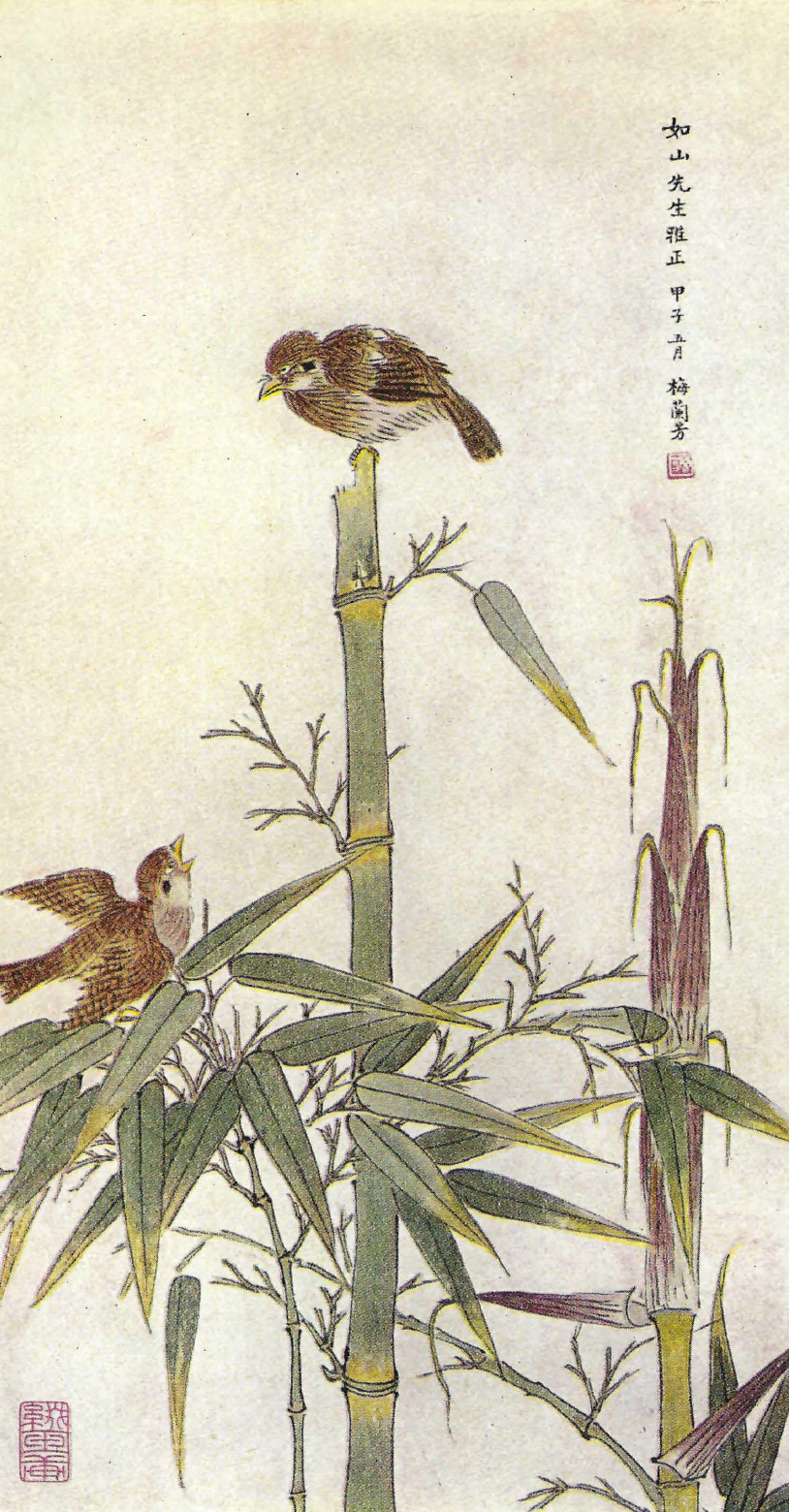
The sponsor pages show the external network that supported Mei’s American tour. Mei Lan-Fang: Foremost Actor of China, by contrast, exhibits how publicity also shaped Mei’s image at the level of self-presentation. A photograph reproduced in the booklet, which was specially prepared for publicity, presents Mei standing between Sir Miles Lampson, then the British minister to China, and Lady Lampson at his residence. The image places Mei within an elite international social world even before the 1930 tour. More broadly, the booklet repeatedly situates him within carefully framed domestic and garden settings and even reproduces one of his own Chinese paintings. Taken together, these materials present Mei not simply as a performer, but as a cultivated host and artist rooted in a recognizable world of traditional Chinese refinement. The booklet thus worked to shape an offstage persona that could support Mei’s authority abroad before he appeared on American stages.

reproduced in Mei Lan-Fang: Foremost Actor of China.
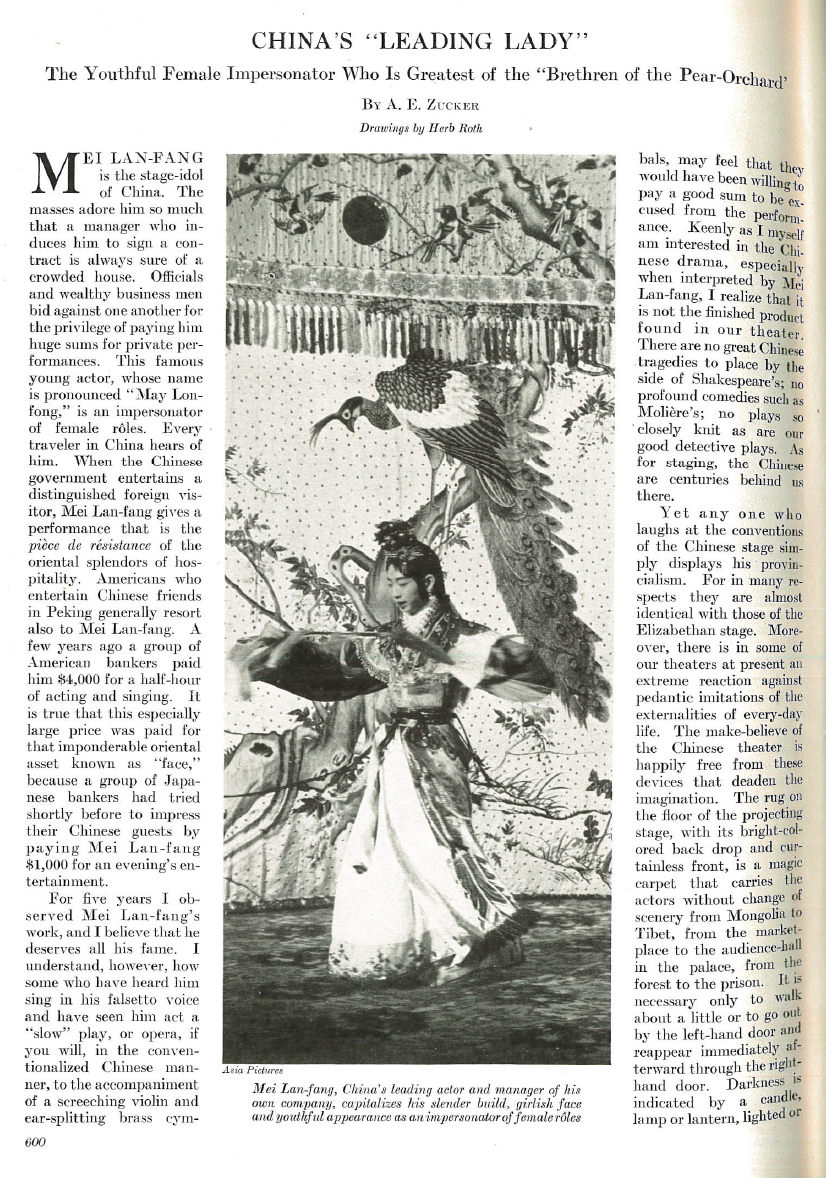
Early American mediation can already be seen in an illustrated 1924 article by A. E. Zucker, “China’s ‘Leading Lady.’” Whereas the publicity booklet fashions Mei’s image from the Chinese side, Zucker translates him into terms more readily available to American readers. He introduces Mei through the familiarizing language of the “female impersonator” and his “girlish” appearance, while also explaining the Chinese stage as a stylized, anti-naturalist form comparable in some respects to the Elizabethan stage. The article is revealing precisely because it does both at once: it makes Mei accessible through gendered novelty even as it tries to secure aesthetic seriousness for his art.
|
|

|
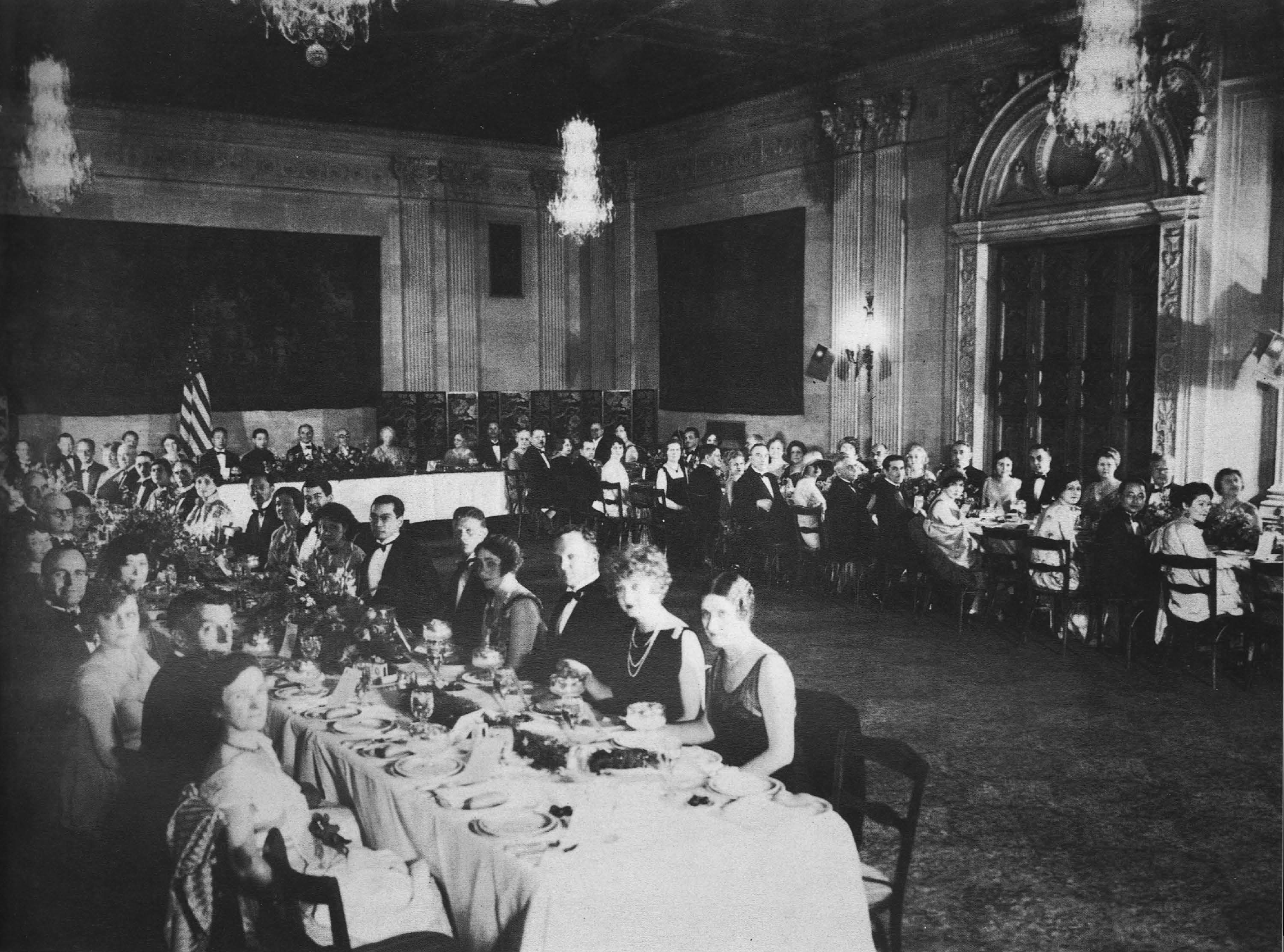
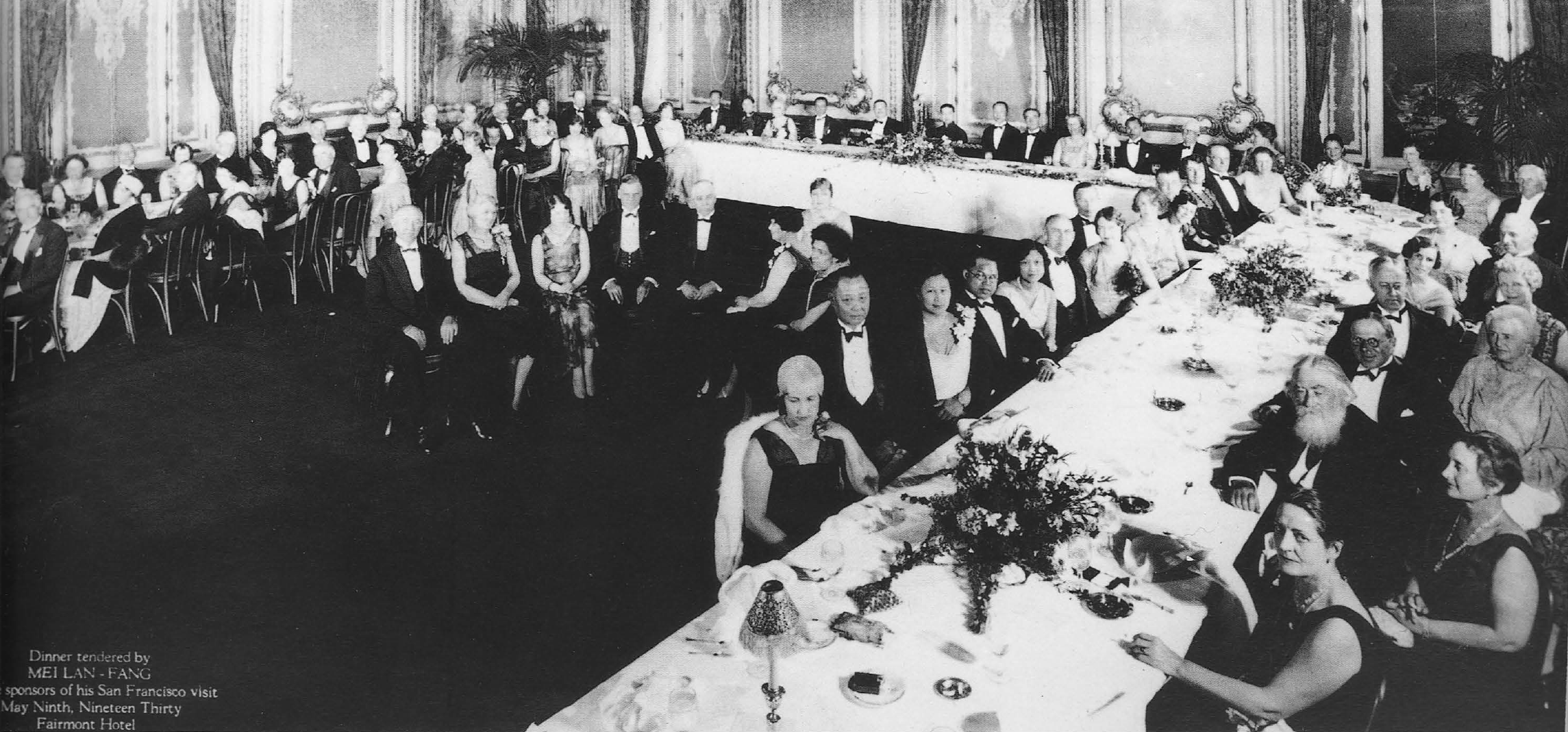
Once the tour entered the mass press, however, this cultivated image could be sharply simplified. A newspaper clipping headlined “‘Actress’ Is a Man” captures one of the most immediate ways Mei was packaged for a broad American readership: as a gendered novelty. Before Mei could be received as a master artist, he was often made legible through surprise, paradox, and spectacle. The accompanying image turns theatrical art into visual curiosity, helping attract attention while threatening to reduce Mei’s artistry to a sensational type. That reduction is all the more striking because Mei’s English-language promoters tried to forestall exactly this misunderstanding. The explanatory booklets insisted that the dan role involved “not realistic impersonation” but “a highly conventionalized artistry,” offering audiences “the idealized charms of a woman” rather than mere imitation.1 In miniature, the clipping reveals a central tension of the tour: the same media logic that made Mei visible could also distort the terms on which his art was understood. The publicity that expanded Mei’s visibility also bound him to a growing round of social obligations. Two banquet photographs from New York and San Francisco reveal the social labor that accompanied Mei’s American success. Soon after his arrival in New York, invitations and receptions were already arriving in an unbroken stream. The San Francisco banquet shows the same pattern continuing as the tour moved westward. Together, these images point to a central tension of the journey: public enthusiasm increased Mei’s visibility, yet the very demands of that visibility limited the time and energy available for sustained artistic observation and exchange.
|
|
|
The honorary degree conferred on Mei by Pomona College marks a different but equally important transformation. Unlike publicity photographs or newspaper images, this document records not a moment of celebrity circulation but an act of institutional consecration. It formally recast Mei as a cultural representative worthy of academic recognition. The rhetoric surrounding the award was revealing. Pomona’s president, Charles Keyser Edmunds, described Mei as a figure whose “researches and adaptations” had advanced American appreciation of the “ancient art of China.”2 Mei, in turn, stressed in his acceptance remarks that “we came to your great country to learn and not to teach.”3 Read alongside those remarks, the diploma demonstrates a crucial stage in the conversion traced in our essay: theatrical fame and public fascination were being translated into cultural prestige, legitimacy, and institutional authority.

Finally, a short video of Killing the Tiger General with Soo Yong’s introduction provides an especially valuable supplement to the print essay because such footage of Mei’s early stage performance is extremely rare. The clip preserves more than a performance fragment. Yong’s spoken introduction echoes the explanatory language found in the booklets and articles, especially the effort to distinguish Mei’s dan artistry from the Western idea of the female impersonator. At the same time, her poised, lively, and distinctly theatrical presence as host reminds us that mediation depended on charisma in explanation as much as on charisma in performance.4 The footage offers glimpses of Mei’s art: costume, gesture, facial control, and stage movement all appear with a degree of immediacy that still photographs can only partially capture.
A second video preserves some of the visual materials in a later reframed form. Although the footage has been incorporated into a comedian’s routine, it still retains valuable historical traces: a brief interview with Mei himself5, as well as scenes of his meeting and conversing with Mary Pickford. In that sense, the clip does more than show the later reuse of archival material. It also allows us to glimpse the original texture of Mei’s American visibility—how he was presented, how he moved within celebrity culture, and how fully his visit entered a broader field of public fascination. Even in altered form, the footage records the degree of attention and welcome that surrounded him in the United States
[1] George Kin Leung, Mei Lan-Fang: Foremost Actor of China (The Commercial Press, 1929), 16.
[2] “Chinese Actor Will Get Honorary Degree at Pomona College,” The Progress Bulletin, May 28, 1930, https://www.newspapers.com/article/progress-bulletin/52392910/.
[3] “Mei Lan-Fang Address Lauded: Great Chinese Actor Accepts Degree,” The Los Angeles Times, May 31, 1930, https://www.newspapers.com/article/the-los-angeles-times/37113381/.
[4] Yong was not merely an interpreter but an experienced performer in her own right: she grew up in Hawai‘i, studied at the University of Hawai‘i and Columbia, and worked on Broadway as well as in early sound film before assisting Mei’s tour. Her role in Mei’s American tour also appears to have further increased her public visibility, as suggested by the separate feature coverage she received in connection with the visit. See Barbara Miller, “Chinese Screen Actress’s Tranquility Envied by Garbo,” The Los Angeles Times, April 14, 1935, https://www.newspapers.com/article/the-los-angeles-times/62702386/; “Chinese Woman Becomes Actress on the American Dramatic Stage,” The Windsor Star, August 8, 1930, https://www.newspapers.com/image/501020654. More broadly, Mei’s successful tour appears to have generated social and celebrity capital for many of the institutions and individuals associated with it, increasing their visibility, prestige, and access to further resources.
[5] The English translation of his original words is: “I feel exceedingly happy. The weather here is wonderful, and so many friends have come to welcome me. I am deeply honored by such a reception.”