


What happens when we take seriously that the more-than-human world creates and stores knowledge through performance? My essay in the June 2026 issue of Theatre Journal explores this question in the semi-arid region of Ceará, Northeast Brazil, where contentious water and drought politics help define the region’s cultural imaginaries. To contribute to understandings of the more-than-human archive and repertoire, I juxtapose water’s performance in two contemporary Cearense ecocritical performance pieces—Dramaturgias da água e da seca (Water and Drought Dramaturgies, 2018) by Pavilhão da Magnólia and A retirante (The Drought Migrant, 2020) by Chico Oliveira and Debora Ingrid—and by the Jaguaribe River, along which the pieces are situated. The Jaguaribe’s flow is a dynamic performance. The river stores and conveys knowledge as repertoire and as a “transitory archive,” as it shifts between physical states—from desiccated to flowing and back again—evoking experiences of suffering from drought, of prosperity, and of the political processes that help determine those experiences. Water’s performance as the Jaguaribe and in the two ecocritical performance pieces is a testament to the region’s chronic socioecological injustices. In this post, I discuss how Pavilhão da Magnólia further develops their interrogation of past and present water-related inequities in Ceará in their production A força da água (The Force of Water, 2024), which builds on Water and Drought Dramaturgies to continue to explore water’s performance across the human and more-than-human experience.
Water and Drought Dramaturgies was a series of experiments that became the building blocks for the full-length production The Force of Water. As I discuss in my full-length essay, Pavilhão da Magnólia carried out experimental performance work and research as part of the 2018 Laboratórios de Criação (Creation Laboratories) through the Porto Iracema das Artes Art School of the Cearense State Government. The performance of Water and Drought Dramaturgies in 2018 in Pavilhão da Magnólia’s performance space in Fortaleza, Ceará, marked the conclusion of the theatre troupe’s participation in the Creation Laboratories.
In 2023, Pavilhão da Magnólia reinitiated the experimental process with director and dramaturg Henrique Fontes, expanding their provocations of water as a physical and political force in and beyond drought-stricken Northeast Brazil. The Force of Water directly interrogates the Drought Industry and its legacies in contemporary Brazilian society.1 At the same time, it universalizes its aqueous themes, moving from the specifics of the Northeastern Brazilian context to a more extensive framework that connects that set of experiences to broader human and ecological issues. On one hand, the production juxtaposes contemporary debates of “water as a right” with water’s ubiquity in the human experience—from water composing sixty percent of the human body to the multitude of water references in the Bible. On the other, scenes integrate the more-than-human experience of water, weaving non-human perspectives into the histories of drought suffering and contemporary water challenges. For instance, one scene consists of a monologue performed by Denise Costa in which the actress confesses her desire to be a fish: “I wanted to be a fish. I wanted to. I swear.”2 She continues, “Have you ever thought about living in that world of water? To breathe underwater. Everything blue.” Costa describes how her sense of smell would guide her through her aqueous world, an abandoned reservoir built by the Brazilian National Department of Works Against Drought (DNOCS), where she would observe the submerged ruins of her childhood town and the fields her father once planted. The scene is framed by references to emblematic reservoirs in Ceará: the Patú Reservoir in Senador Pompeu, which is tied to Ceará’s campos de concentração (concentration camps), and the Cedro Reservoir in Quixadá, the first large-scale reservoir constructed by the Brazilian government in the late 19th century to address drought in Northeast Brazil.3
As a research collaborator, I participated in the devising process of The Force of Water, contributing my knowledge of contemporary water relations in the rural interior of Ceará where I was living and conducting my ethnographic fieldwork for my dissertation on water insecurity. Throughout the development of The Force of Water, I shared insights from my ongoing research with rural communities “in the field” with Pavilhão da Magnólia and their director, Henrique Fontes. This included a visit to my home in Quixeramobim, Ceará, on their return to the capital, Fortaleza, after a research trip to the ruins of the campos de concentração in Senador Pompeu (Figure 1). A primary objective of these exchanges was to better represent the contemporary challenges faced by rural sertanejos, as most of the members of Pavilhão da Magnólia, who were from the state capital Fortaleza, did not have first-hand experience with these realities.4 Yet, as a white (Jewish) US researcher, I also questioned if I was the “right” person to share this type of knowledge. I partially addressed this ethical question throughout my fieldwork by cultivating an ethnographic ethos of “coperformative witnessing,” which Dwight Conquergood considers, “a riskier hermeneutics of experience, relocation, copresence, humility, and vulnerability.”5 Contributing to The Force of Water became one way that I could use my own positions of power to help make more visible the everyday struggles of many of the families with whom I lived and carried out fieldwork in Quixeramobim.
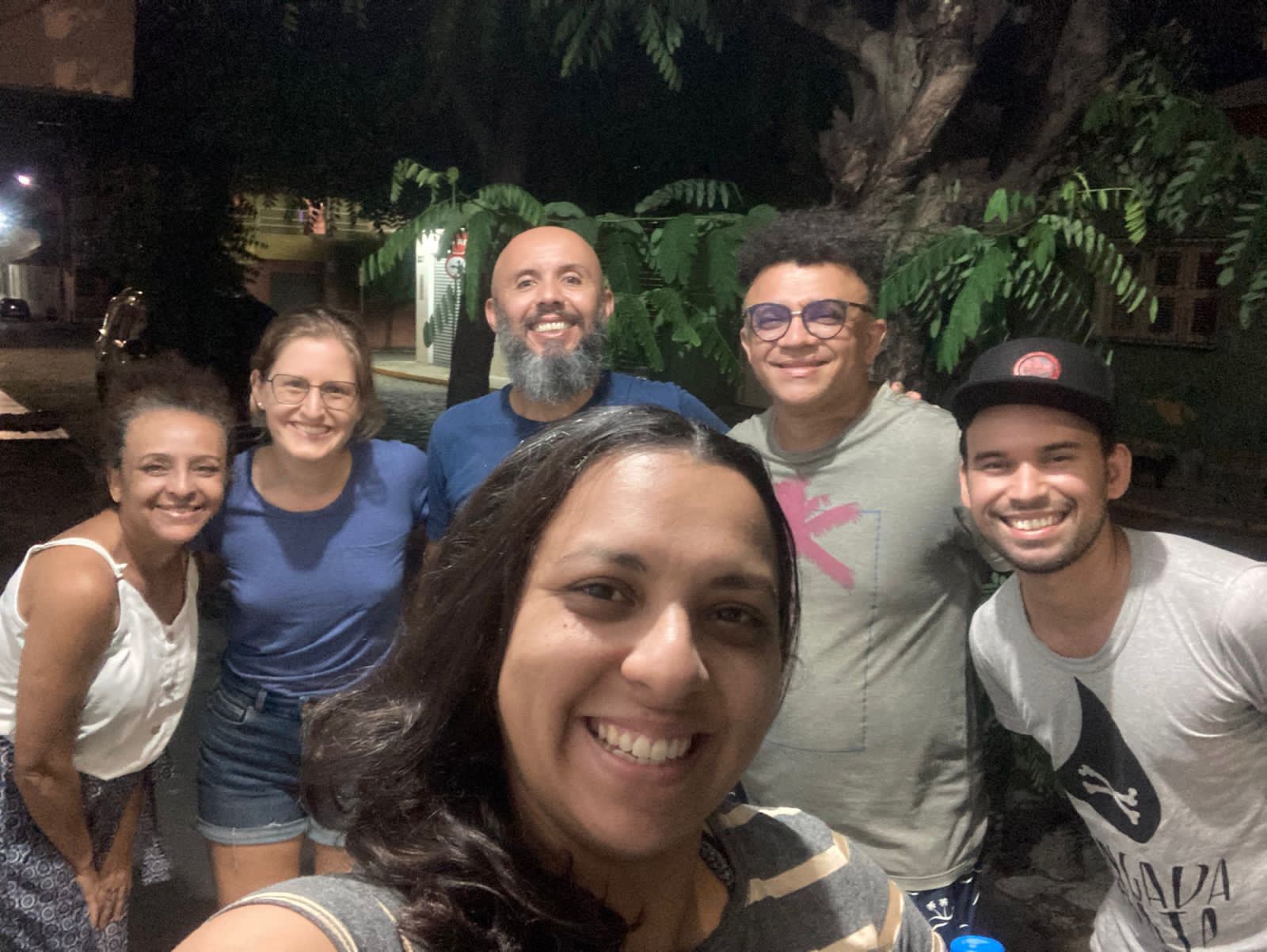
Quixeramobim, Ceará, in June 2023 to discuss my ongoing ethnographic
research on water relations in rural Ceará during the devising of The Force
of Water. Back row (from left to right): Denise Costa, Cydney Seigerman
(author), Henrique Fontes, Nelson Albuquerque, and Eliel Carvalho.
Front row: Silvianne Lima.
When Fontes asked each of us to write a scene that evoked the working title of the production, Ninguém Segura a Força da Água (No One Secures the Force of Water), I composed a monologue by a rain-harvesting cistern, Madam Cistern, who recounts the joys and distress of her experience as a cistern securing water for an impoverished family in rural Northeast Brazil.6 During homestays and interviews, I witnessed how, over the past twenty five years, the construction of rain-harvesting cisterns by means of government-sponsored cistern programs drastically improved access to potable water for the families I met. Yet, as the provocation suggests, even the 16,000-liter cisterns cannot definitively secure the force of water. For example, during prolonged drought from 2012 and 2018 in Ceará, household cisterns dried up and water delivered by water trucks (carros pipas) replaced the coveted rainfall. In the monologue, which became part of the final production, Madam Cistern laments that during this period of drought, she was only filled up partially by a water truck. This is a common experience for rural households, as a single water truck (which may carry a volume of 10,000 to 16,000 L) often distributes water across multiple cisterns on its route. Furthermore, cisterns are more likely to develop cracks when holding little water: in the scene, Madam Cistern grieves her inability to secure water for her family due to a crack that she developed during a period of drought. Madam Cistern’s monologue vocalizes the contributions of household cisterns to the more-than-human archive and repertoire. Through their ability or failure to store water, household cisterns transmit, transform, and generate knowledge of drought, the politics of water access, and the lived experience of water (in)security.
Fontes’ provocation of who or what might control the force of water reinforces water’s performative nature. Water is a multifaceted agent that actively shapes landscapes and cultural imaginaries through its flow or its absence. As Farhana Sultana observes, water “[…] seeps across all boundaries and all aspects of life, as it is simultaneously social, economic, political, institutional, cultural, spiritual and ecological.”7 The Force of Water debuted in Fortaleza in 2024. Since then, its performance across Brazil has contributed to a contemporary Northeastern Brazilian imaginary that confronts the legacies of drought-related suffering and injustice in contemporary water realities. In an interview with Gleice Magalhães of Mercado da Arte, an online program focused on Cearense culture, the members of Pavilhão da Magnólia discussed how Cearense humor and irony throughout helps the audience engage with the difficult topics of Northeastern Brazilian history, which remain largely unknown by the general public.8 The theatre troupe gained national recognition for The Force of Water, winning the 2025 Shell Theatre Award for The Force of Water in the category “Destaque Nacional” (“National Standout”). The Shell Awards (O prêmio Shell de Teatro) recognize artistic excellence in Brazilian theatre. In a review of The Force of Water, theatre critic Rodrigo Morais Leite noted this recognition as well-deserved, applauding Pavilhão da Magnólia for the “semantic richness” of the piece and cenopoesia (scenopoetry), or the integration of diverse artistic languages to foster critical social reflection, in the interrogation of the “troublesome topic” of the Drought Industry and broader social issues.9 Water in The Force of Water transcends local imaginaries and political struggles, reminding us that it is a more-than-human performer whose agency or force cannot be fully contained.
|
|
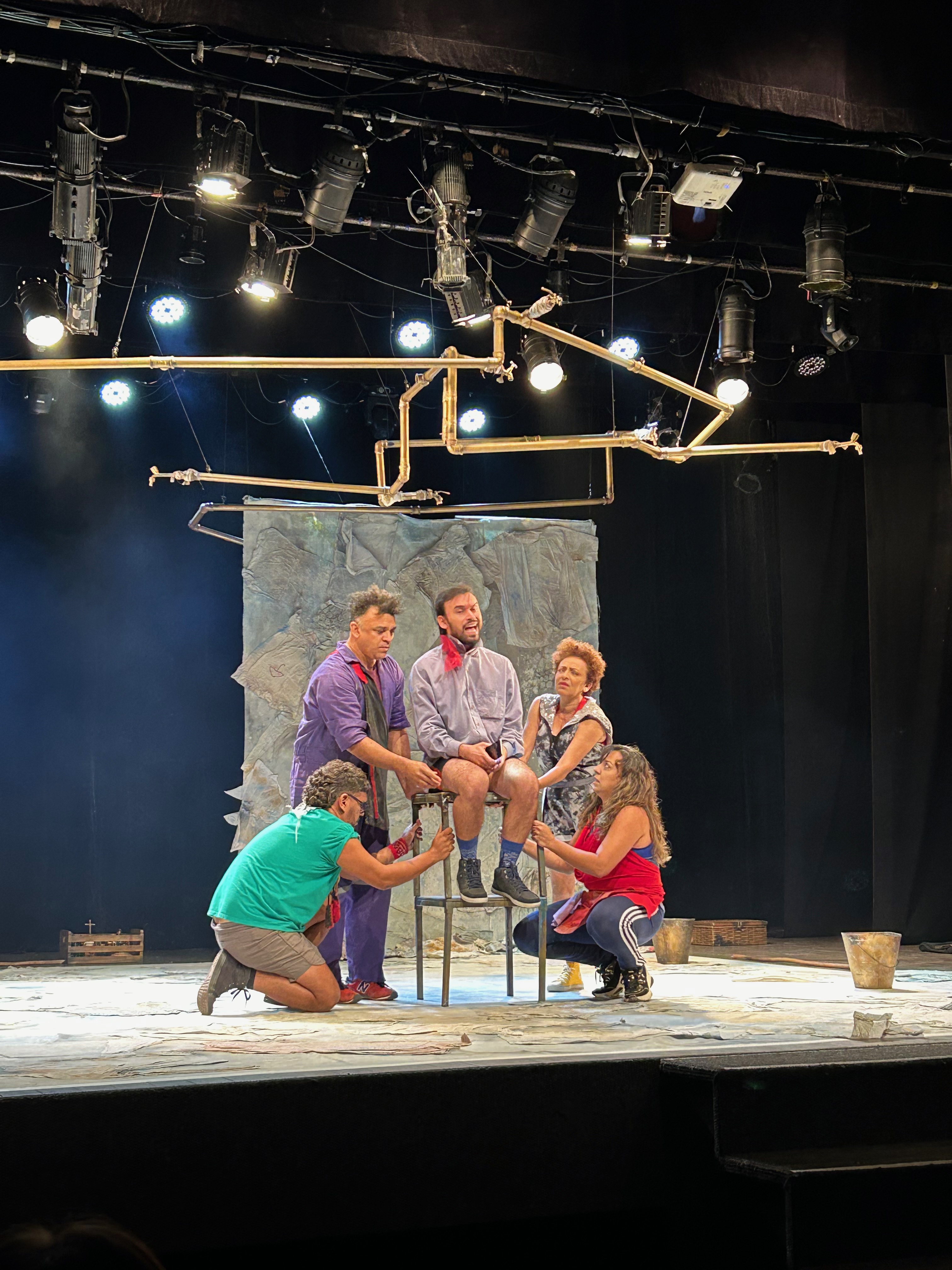
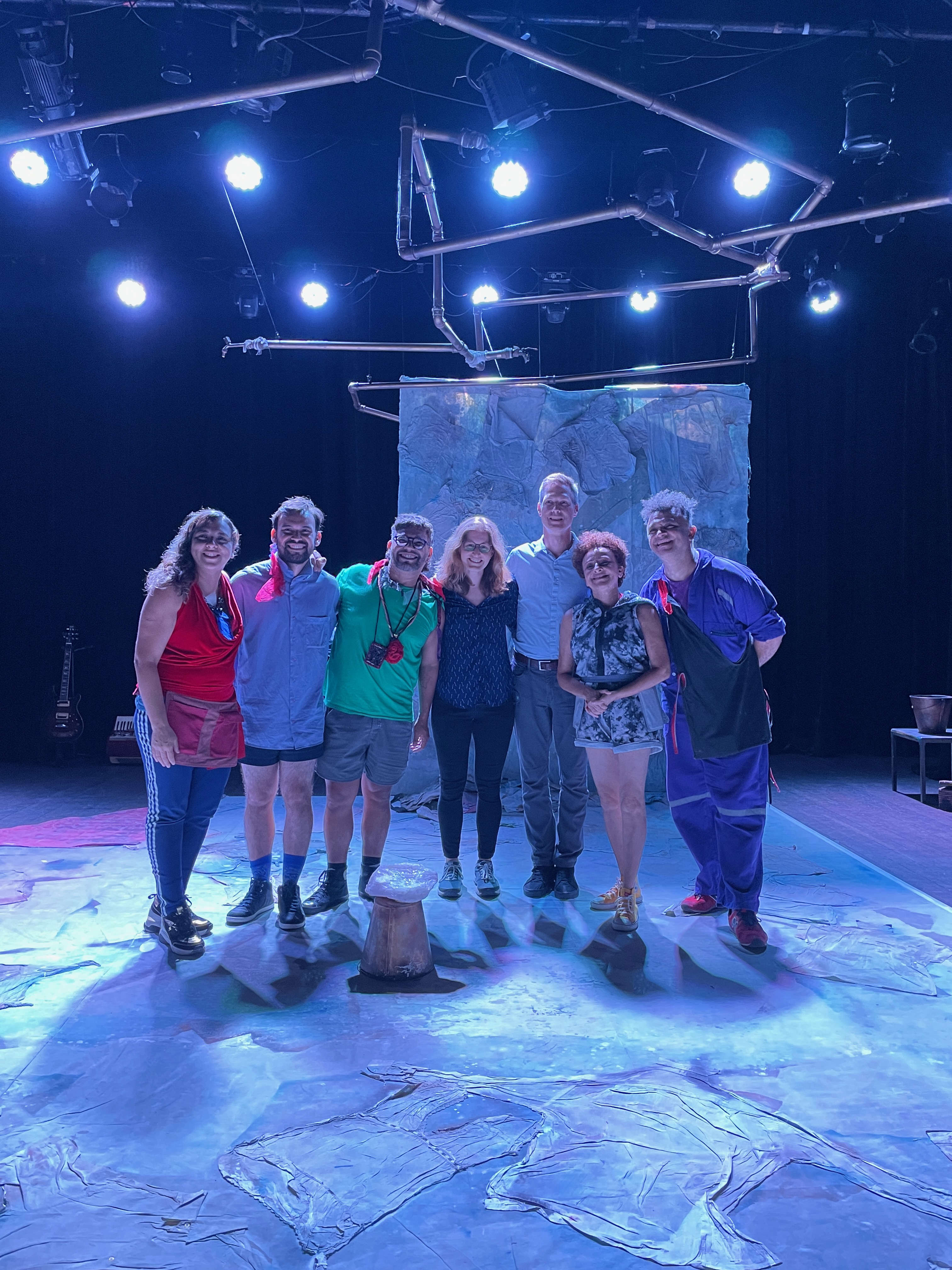
Figure 2. During and after the performance of The Force of Water I attended in Fortaleza, Ceará, (July 20, 2024).
[1]The Drought Industry (“A Industria da seca” in Portuguese) refers to the corruption and the financial gain by the political and industrial elite in Northeast Brazil at the expense of the rural poor through the construction of large water infrastructure throughout the twentieth century. Roberto Marinho Alves Silva, “Entre o Combate à Seca e a Convivência com o Semi-árido: Políticas Públicas E transição paradigmática,” Revista Econômica Do Nordeste 38, no. 3 (2017): 472, https://doi.org/10.61673/ren.2007.539.
[2] Translation by author.
[3] There is scarce research on the campos de concentração in Ceará, which were built and run by the Cearense government to control drought migrant populations during the extreme droughts of 1915 and 1932. Although the Cearense campos de concentração were sites of illness, starvation, and death, they were not equivalent to Nazi extermination camps. Ongoing work continues to provide more in-depth understandings of the dynamics of the camps and the suffering experienced by drought refugees. Kênia Souza Rios, Isolamento e poder: Fortaleza e os campos de concentração na seca de 1932 (Imprensa Universitária, 2014), https://repositorio.ufc.br/bitstream/riufc/10380/1/2014_liv_ksrios.pdf
[4] Silvianne Lima, in discussion with the author, November 27, 2020.
[5] Dwight Conquergood, “Performance Studies: Interventions and Radical Research,” TDR 46, no. 2 (Summer 2002): 149. https://www.jstor.org/stable/1146965
[6] An early version of the scene is published in Platypus, the official blog of the Committee for the Anthropology of Science, Technology & Computing (CASTAC) of the American Anthropological Association: https://blog.castac.org/2023/08/madam-cistern/
[7] Farhana Sultana, “Water Justice: Why It Matters and How to Achieve It,” Water International 43, no. 4 (2018): 484, https://doi.org/10.1080/02508060.2018.1458272.
[8] Grupo Pavilhão da Magnólia, “MDA | A força da água,” by Geice Magalhães, Mercado da Arte, YouTube vídeo, March 22, 2025, https://www.youtube.com/watch?v=VYk32IVKGEY.
[9] Rodrigo Morais Leite, “A Força da Água, grupo Pavilhão da Magnólia: A Indústria da Seca em Forma de Poesia Cênica,” Cultura – Arte – RMVale, April 17, 2026, https://cultura.sjc.br/critica-a-forca-da-agua-grupo-pavilhao-da-magnolia-por-rodrigo-morais-leite-no-39o-festivale/. Translation by author.